
Insight to Action: Turning Data into Measurable Results

John Q. Todd
Sr. Business Consultant/Product Researcher Total Resource Management (TRM), Inc.
December 4, 2025
Data (or perhaps we should say the analysis of it) tells us things every day. The car is low on gas. The boiler tripped off again today. Revenue for the quarter is down. Contractor costs jumped 5% over the last phase of the project. Overtime remained level this month.
One could argue that even the lack of data, once discovered, can provide insights. “Oh, I didn’t know,” is the typical response to gaining an insight that… well… you didn’t know about.
No matter what the source of data or what the context of the insight is, the question is, what do you do with that insight?
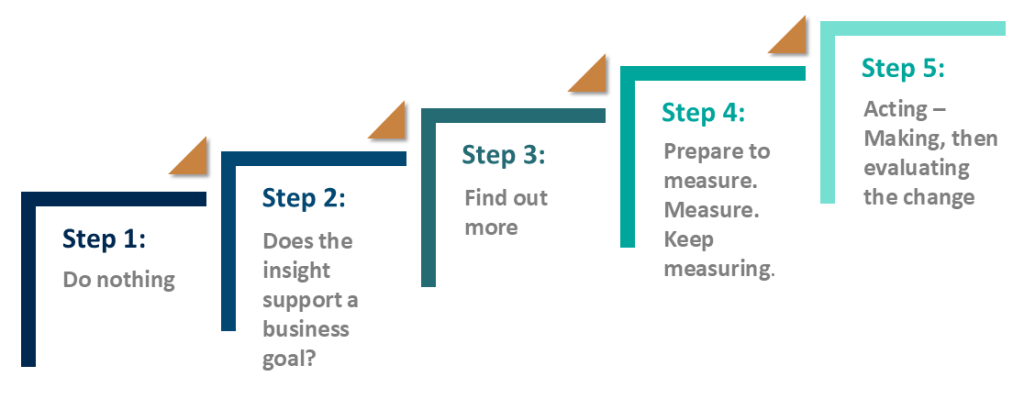
Step 1: Do nothing
Many observations or results of analysis are rather small with the degree of insight that they are delivering. A 1% jump in something might be a huge deal, or perhaps at the level of a rounding error. That same jump could be an indicator of a trend that will need to be addressed, but perhaps not right now. Take a moment to consider two things: 1) Is this insight worth looking into and 2) what will “doing something about it,” accomplish?
Step 2: Does the insight support a business goal?
A business goal could be local such as a maintenance budget or up at the corporate level such as a margin or revenue. No matter the level of the goals that drive the daily activities, the insight from the data needs to be related. What may seem like a valuable insight that can have an impact on business operations, might not ultimately support a business goal. It’s even worse if the insight prompts improvement efforts that do not move the needle when measured at the local or corporate level.
As an example, say there is an insight from the data that points to being able to postpone preventive maintenance activities on a type of pump to every quarter vs. each month. The savings in labor and materials may be locally significant depending upon the nature of the equipment. Given the assumption that this reduced amount of attention will not cause issues in the future of the equipment, making this change to the process is reasonable.
If there is scale to this change, in that the reduction will occur across numerous pumps of this type, there is a possibility that it will move the needle at the corporate level. Increased margin, lower operating costs, etc. It is unlikely, however, that this change, if only for a few pieces of equipment, will have a measurable impact on the higher-level goals.
This step may require speaking to the higher levels in the organization to get their take on the impact that a change may have. On the surface, a potential change may look impactful, but when blended in with everything else, it could easily get lost. Find out where in the financial reporting structure the impact of change would be recorded or made visible. Often the accounting approach of an organization could obfuscate the impact of most tactical changes.
Step 3: Find out more
The insight has value even if ultimately it gets passed over. The simple fact that you have something to explore means you are making use of the data at hand vs. just letting it collect in the database. The process that generates insight has inherent value.
Armed with the finding, dig deeper into the raw data that generated it. You are looking to cement the credibility of the insight no matter how it was generated. Ranging from a manual analysis process, all the way to a machine learning/AI system, the foundation behind the insight needs to be validated.
Once the credibility of the insight is established, estimating the impact of any changes it could lead to is necessary. Back to the beginning of this article: “What is the expected impact?” This is the difficult part, estimating the impact in financial terms near- and long-term, and relating to local or corporate goals.
Step 4: Prepare to measure. Measure. Keep measuring.
On paper, the changes due to the insight may look very compelling. The proof of course will be real data about the impact of the changes over time. Part of the decision-making process that happens well before implementing changes is determining how the impact will be measured. Make accommodations for negative results! It is very possible that the captured data after the change will show things went in the wrong direction. Do not assume that the change will always be positive or come even close to the level(s) expected.
However, there is value in making changes that perhaps do not pan out. True, most changes implemented should have measurable and visible results, but not all will. The point is that you have a program and the discipline to leverage the data at hand, make decisions and changes, most of which benefit the business.
Enable change data to be collected with minimal human involvement. If the data collection process for the change is too burdensome for those who are executing it, you will end up with nonsense or simply no data at all. In fact, greatly reducing the need for manual data entry in any process has great value, so factor that into the approach to the change.
When a change has proven itself in measurable ways, celebrate! Perhaps this data will bring out more insights as it is analyzed.
Step 5: Acting – Making, then evaluating the change
If the people and processes most impacted by the change have had a voice into the details of the change, it is time to implement. If the change has been a long time in the making, a review might be warranted so everyone involved has the same vision of what is next.
Be sure the change is obvious. Leverage your documentation program to update the process with a new version. Be sure any supporting systems are modified and those changes documented (and tested!) in case troubleshooting needs to occur.
A singular change can be a member of a larger group of changes that are deployed all at once. Be cautious with this activity, but under the right circumstances it is a credible approach.
Using feedback, measurements, expectations, and observed impact, evaluate the change. Did it have the desired set of effects? Did it move the needle locally or corporately?
Wrap up
TRM has been assisting clients across industries to capture the right data and then use the data to gain insights. With the right tools and strategies in place, executives and all levels of roles gain the visibility they need—without the overburden of unused reports. Every client has different needs in this area, but tools such as IBM Maximo and those related provide the foundational functions everyone can use. If your organization is ready to transform data into decisions that matter, Total Resource Management is here to guide the way.
Ready to elevate your asset management?
Connect with TRM to start your journey toward exceptional performance.
Related Resources
Explore insights, guides, and tools designed to help you unlock greater asset management performance and business value.

Unlock smarter
asset management
Ready to elevate your asset management?
Connect with TRM to start your journey toward
exceptional performance.