Why EAM Implementations Fail – How to Fix Them

William J. Goetz
VP of Corporate Development TRM
March 18, 2026
In a recent executive panel, TRM and IBM leadership came together to explore the realities of Enterprise Asset Management Systems (EAM). A key insight from the discussion was that most EAM “failures” aren’t actually failures of the software itself. Instead, they stem from underlying organizational challenges: they’re the result of weak or inconsistent processes, poor-quality data, and a lack of active executive ownership. Panelists emphasized that asset management should be treated as a strategic lever to drive operational performance and long-term value, rather than merely as a cost center to be minimized.
Here are some of the high points from the panel:
Why EAM Projects Disappoint
Even when EAM/CMMS software is successfully installed, executives often look back and ask themselves, “What did we really get for our money?” That gap exists because many programs are scoped primarily as IT rollouts rather than as comprehensive business transformations tied to uptime, cost, and safety targets.
When organizations instead approach EAM as a transformation of how they plan, schedule, stock, and govern maintenance rather than just how they track work orders, the impact can be profound. EAM can drive measurable improvements in production efficiency, maintenance costs, and operational risk management.
To make that shift from implementation to impact, executives need to ask a different set of questions. These questions are designed to guide conversations in steering committees, budget reviews, or board updates – helping to shift the conversation from the “system” itself to the “strategic value” it delivers. By asking the right questions, executives can ensure that EAM initiatives are not just technology projects, but drivers of operational performance, risk reduction and long-term business outcomes.
Three Questions Every Executive Should Ask
1. Are we implementing software, or improving how we run the plant?
- If the primary goal is “go live” on an EAM, you’ll likely automate today’s problems and get bad information faster.
- If the goal is measurable gains in throughput, maintenance cost, and safety, your decisions around scope, sequencing, and staffing will look very different – focused on transformation, not just installation.
2. Who owns asset management outcomes at the executive level?
- Sustainable turnarounds only happen when senior leadership takes visible ownership, not merely offers “support”.
- Without that accountability, efforts stall at the maintenance manager level and are often reset whenever leadership changes, preventing lasting impact.
3. Is our data good enough to support ahigh-performance system?
- Many organizations simply migrate poor master data into a new system and expect different results.
- Without clean asset hierarchies, accurate BOMs, criticality ratings, and reliable inventory data, advanced tools like APM, predictive analytics, and AI can’t deliver value.
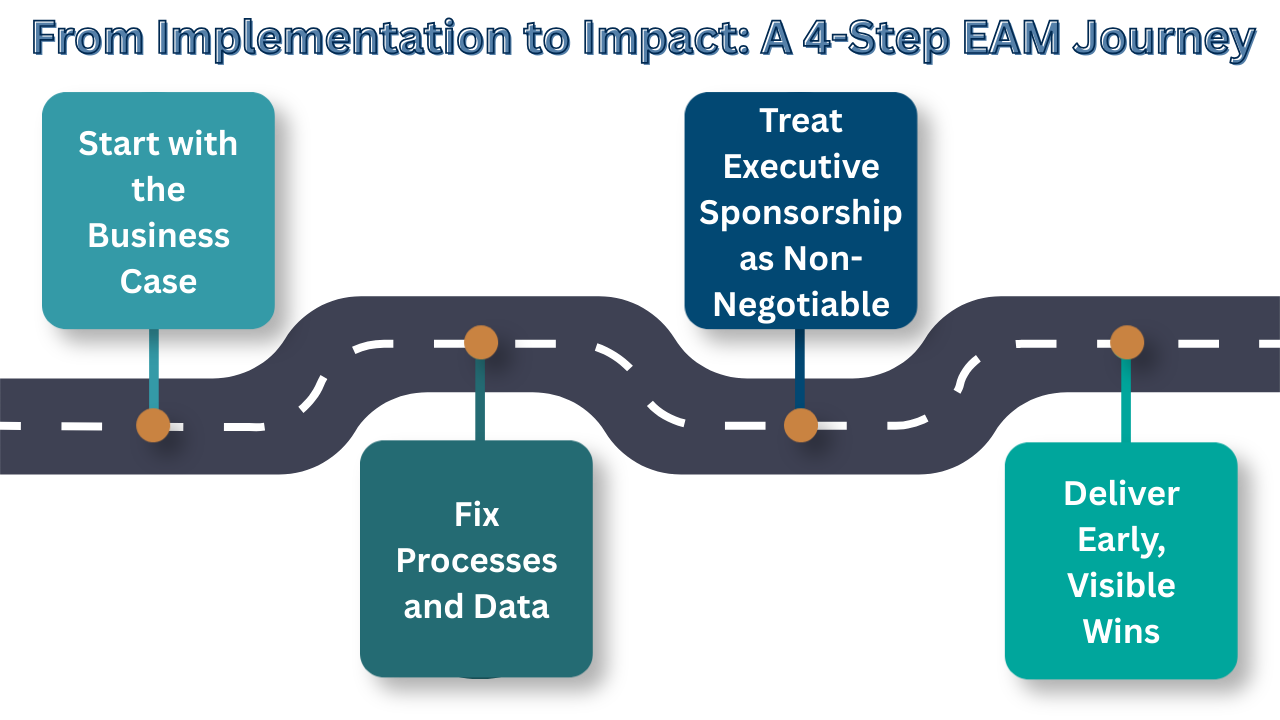
A High-Level Approach That Actually Works
Here’s a practical, executive-level roadmap you can share with your team – and then invite them to explore in more depth by watching the full panel discussion.
1. Start with the Business Case, Not the Feature List
- Define clear value levers: reduced maintenance spend, fewer unplanned outages, better inventory turns, extended asset life, and improved warranty recovery.
- Build a 3–5-year value case that executives can track with a small set of meaningful business metrics, not just an ROI slide.
2. Fix Processes and Data Before You Go Fancy
- Standardize core maintenance processes (work identification, planning, scheduling, failure coding, and materials management) and align EAM configuration to those playbooks.
- Clean and rationalize master data instead of lifting-and-shifting legacy structures into the new platform.
- Advanced capabilities based on II0T-based predictive analytics will deliver far more from a firm footing.
3. Treat Executive Sponsorship as Non-Negotiable
- Engage senior leaders in defining targets, reviewing progress, and visibly supporting cultural change across maintenance, operations, engineering, finance, and procurement.
- Leverage the business case and early wins as a scoreboard to keep leadership committed over the 4–6 year transformation journey.
4. Deliver Early, Visible Wins to Fund the Journey
- Target low-hanging opportunities such as improved planning and scheduling, applying condition-based maintenance to a small set of critical assets, and basic inventory optimization.
- Use the gains in technician productivity, reduced expediting, and warranty recovery to build confidence and reinvest in the broader program.
- Target and track gains in product output.
Real Results from the Panel
Our expert panel shared compelling examples of what’s possible when EAM is treated as business transformation not just a system rollout:
- A chemical plant struggling at 55% of nameplate capacity for five years spending $8M annually on maintenance implemented process improvements and proper EAM configuration. Within three years, the plant achieved 110% capacity while cutting maintenance spend to under $3M.
- What made the difference? Executive ownership, process redesign before software configuration, and replacing time-based maintenance with predictive approaches, all enabled by proper master data and a properly configured system.
Watch the Full Discussion
To hear more real examples, including plants that doubled output while cutting maintenance spend in half and to dive deeper into how executives should lead these transformations, watch our on-demand executive panel:
The panel featured:
- Dick DeFazio, General Manager of Consulting at TRM (formerly founder of Performance Consulting Associates)
- Bob DiStefano, Senior Vice President of Consulting at TRM (formerly founder of Management Resources Group)
- Tom Wogenrich, IBM Center of Excellence Leader for Maximo
- Ray Miciek, Sr Vice President of Strategic Partnerships at TRM
Together, they bring over 140 years of hands-on experience helping industrial organizations get more from their existing assets and people, not through pilots or proofs of concept, but through real, sustained performance turnarounds.
Key Takeaway
Technology is powerful, but it’s only one leg of the stool. People, processes, and technology must work together, with executive leadership driving the cultural transformation that turns maintenance from a cost center into a strategic driver of profitability.
Don’t let your next EAM investment become another “successful implementation” that disappoints at the executive level. Approach it as the business transformation it needs to be, and unlock measurable gains in uptime, cost, and operational performance.
If you’re ready to turn EAM into a measurable driver of performance, let’s continue the conversation. Contact Us | TRM
Ready to elevate your asset management?
Connect with TRM to start your journey toward exceptional performance.
Related Resources
Explore insights, guides, and tools designed to help you unlock greater asset management performance and business value.


Unlock smarter
asset management
Ready to elevate your asset management?
Connect with TRM to start your journey toward
exceptional performance.