Asset Performance Management – The Power of Threes!

Dan Moss
Senior VP Consulting Operations TRM
February 23, 2026
“The best laid plans of mice and men often go awry” was first coined by Scottish poet Robert Burns and later formed the theme of John Steinbeck’s 1937 novel, ‘Of Mice and Men’. This phrase is all too often applicable in the realm of Asset Performance Management. Massive amounts of capital are flowing towards infrastructure build-out to support the Artificial Intelligence revolution that is taking place around the world. Will these data centers, power generation systems, and power grids perform in line with promises and expectations? In all likelihood there will be bumps along the way, expectations will be scaled back, and the final performance will be something less than what could be… but this doesn’t have to be true. The secret to reaching optimum asset performance rests in the “Power of the Threes”.
From Design to Operation
Let’s start with some basics. From an Asset Reliability Strategy perspective, all equipment has a finite life. For some, this life is easily measured such as the deterioration of iron in a humid environment. For others, like the population of bearings in rotating equipment, there are formulas that provide an average expected lifespan. In all cases the life of equipment is finite AND it is impacted by the operating context. In other words, whatever the finite life is, it will be impacted by the context of where it is, how it is operated, and how it is maintained. In reality, equipment at its design has a finite life with an inherent reliability. Essentially everything from that point on can either ensure the inherent reliability and operational life or (in the majority of cases) degrade them.
One other key point, most plants do not consist of a single piece of equipment but a grouping of equipment, either to form a production line or as multiple independent production units. In either case, the overall reliability of the production line is the product of the reliability of each piece of equipment that makes up the line. Therefore, optimal plant performance is based upon providing each piece of equipment with what it needs for optimal reliability. The definition of reliability is when the equipment performs its intended function over time within its design operating context. It does what it is supposed to do when required.
Getting Started
When capital dollars are spent building a new plant, there is a hand-off that takes place from the builders to the team who will operate, maintain, and manage the plant. At every step in the process, decisions and actions can unintentionally diminish future reliability and performance. Installation, commissioning, and start-up must follow precision steps including comprehensive and accurate transfer of information to the team who will operate, maintain, and manage the plant. Some of the crucial steps include setting all equipment to precision standards, capturing all master data on the equipment and spare parts into a robust platform, and ensuring that the hand-off is smooth and complete.
Processes, Platform, People
In ensuring optimal asset performance, the first set of threes is to ensure the 1) processes, 2) platform, and 3) people are all aligned. The processes refer to the way activities are structured and acted upon to get things done. The platform is the software / hardware system used to manage all the activities, data, and information associated with the processes. The people follow the processes and utilize the platform to make decisions and take actions that enable the equipment to do what it was designed and installed to do. Deficiencies in any one of these limits asset performance.
Processes: Work Management, MRO Inventory and Stores, Reliability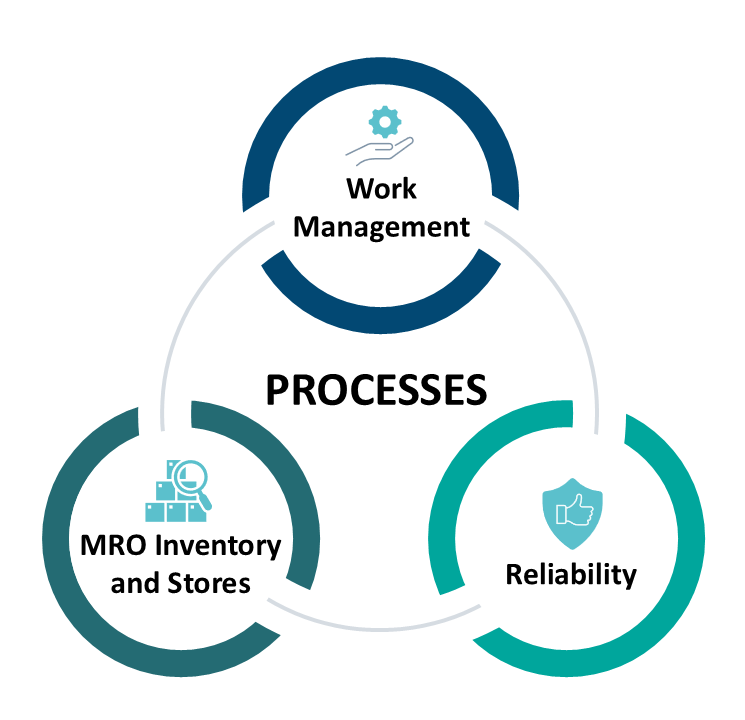
Depending upon the type and complexity of the plant, there are several processes that come into play. There are three that stand out for any equipment-centric plant or asset. They are 1) work management, 2) MRO inventory and stores, and 3) reliability processes. Work management processes ensure that proper maintenance and care activities are being performed at the appropriate time and in the most efficient manner. MRO inventory and stores processes address the spares parts activities to meet the maintenance, repair, and operational needs of the plant in the most cost effective and efficient manner. Finally, the reliability processes are the various techniques that work together to enable assets to achieve optimal reliability performance.
Platform
The platform refers to the Computerized Maintenance Management System (CMMS) or Enterprise Asset Management System (EAM) that is the repository of all asset-related data and dynamic information. The asset hierarchy resides within the platform and all data related to the asset should be collected or available through use of the platform. The work order system resides within the platform and captures all activity required and performed on the equipment. Over time the data builds, creating a treasure trove of information that the plant team can access and use to make good business decisions.
People
Finally, the people must understand the mission of the plant and their roles and responsibilities in fulfilling the mission. Consistent communication and appropriate training are critical to ensure the team is aligned and equipped with knowledge and skills to operate, maintain, and manage the equipment. When performance degrades it is essential to assess, understand, and return to the practices and processes that enable best performance. Individual and organizational change management should be applied to restore peak performance.
Levels: Management, Operations, Maintenance
The next group of three is 1) Management, 2) Operations, and 3) Maintenance. Management consists of the formal leaders within a plant tasked with establishing and sustaining a clear strategic vision, mission, and high-level tactical plan for plant success. Operations encompass middle management level and hourly team members who operate the equipment to produce the company’s products or services. Maintenance encompasses middle management and hourly team members who perform or manage the predictive and preventive maintenance as well as all corrective repairs to the equipment.
Management
Senior leaders will live in the strategic realm, looking months down the road for where the plant needs to be and what it will take to get there. Their tactical skills are necessary, but the greater value to the plant and to their team rests in their ability to effectively guide the organization into making wise decisions now to end up where they want to be in the future.
Not surprisingly, the focus area for the three levels can be described in three ways with a distribution of time and energy shifting depending upon the role and level in the organization.
Operations
At the supervision and middle management levels, the perspective changes to be mostly tactical. Understanding the plan for the day, the week, and how to ensure various work groups operate seamlessly together is the major responsibility. This level will need to be able to understand how the strategic elements inform the tactical plan to ensure assets operate at peak efficiency or, if performance lags, how to return to best- in-class levels.
Maintenance
At different levels of the organization from floor staff to plant leadership, there is an associated shifting of perspective and responsibilities. At floor level, operators and maintenance technicians must be technically skilled in their work. Making repairs and troubleshooting operational issues requires a high degree of technical competency. Having a solid grasp of the tactical plans for plant improvement is helpful, though less critical. They do not need to devote much attention to the strategic big picture. To understand that there is a strategic plan and that their role is important within that plan is appropriate, but the greatest value is in the direct application of their skills operating and performing maintenance with technical competency.

- Senior Management – 70% strategic, 25% tactical, 5% technical
- Middle Management – 25% strategic, 60% tactical, 15% technical
- Hourly Operator or Maintainer – 5% strategic, 15% tactical, 80% technical
Optimal Performance
Achieving optimal performance is not a matter of luck. It is not a matter of capital dollars. It is not even a matter of good ideas and innovation. Optimal asset performance is leveraging the power of threes… processes, platform, and people… work management, MRO inventory and stores, and reliability…management, operations, and maintenance… strategic, tactical, and technical. When all of these threes are optimized and aligned then, and only then the capital dollars, the good ideas, and the innovations can deliver the reliability and performance they were designed for. Luck no longer has anything to do with it. And both mice and men will be pleased because the best laid plans no longer go awry.
TRM has been assisting clients across industries to implement technological solutions to enhance the performance and reliability of processes and platforms. TRM continues to be at the forefront of the technological solutions that are available, yet we also have practical experience and understanding to know where they do and do not fit. Download the Ebook: Maximizing Equipment Productivity with APM Strategies and let TRM help you build a reasonable roadmap to Asset Performance excellence that is not only achievable but also will have the desired impact on the organization.
Contact us at TRM or email us at askTRM@trmgroup.com.
Follow Dan Moss on LinkedIn for proven strategies and practical guidance in reliability and asset performance management.
Ready to elevate your asset management?
Connect with TRM to start your journey toward exceptional performance.
Related Resources
Explore insights, guides, and tools designed to help you unlock greater asset management performance and business value.


Unlock smarter
asset management
Ready to elevate your asset management?
Connect with TRM to start your journey toward
exceptional performance.