
Driving Grid Reliability: Improving SAIFI, CAIDI, SAIDI

Brian Edens
Senior Director of Energy and Utilities Sales TRM
March 30, 2026
How IBM Maximo Application Suite and TRM Improve SAIFI, CAIDI, and SAIDI in Energy & Utilities
Introduction
Reliability is the foundation of customer trust in the Energy and Utilities industry. When outages occur, customers expect quick restoration and minimal disruption. Regulators also closely monitor reliability performance, making metrics like SAIFI (System Average Interruption Frequency Index), CAIDI (Customer Average Interruption Duration Index), and SAIDI (System Average Interruption Duration Index) critical benchmarks for utilities.
Improving these metrics isn’t easy. Aging infrastructure, unpredictable weather events, and siloed operational systems often stand in the way. That’s where IBM Maximo Application Suite (MAS), combined with TRM’s proven expertise, comes in—helping utilities move from reactive to preventive strategies that directly impact CAIDI, SAIDI and SAIFI scores.
Understanding SAIFI, CAIDI, and SAIDI
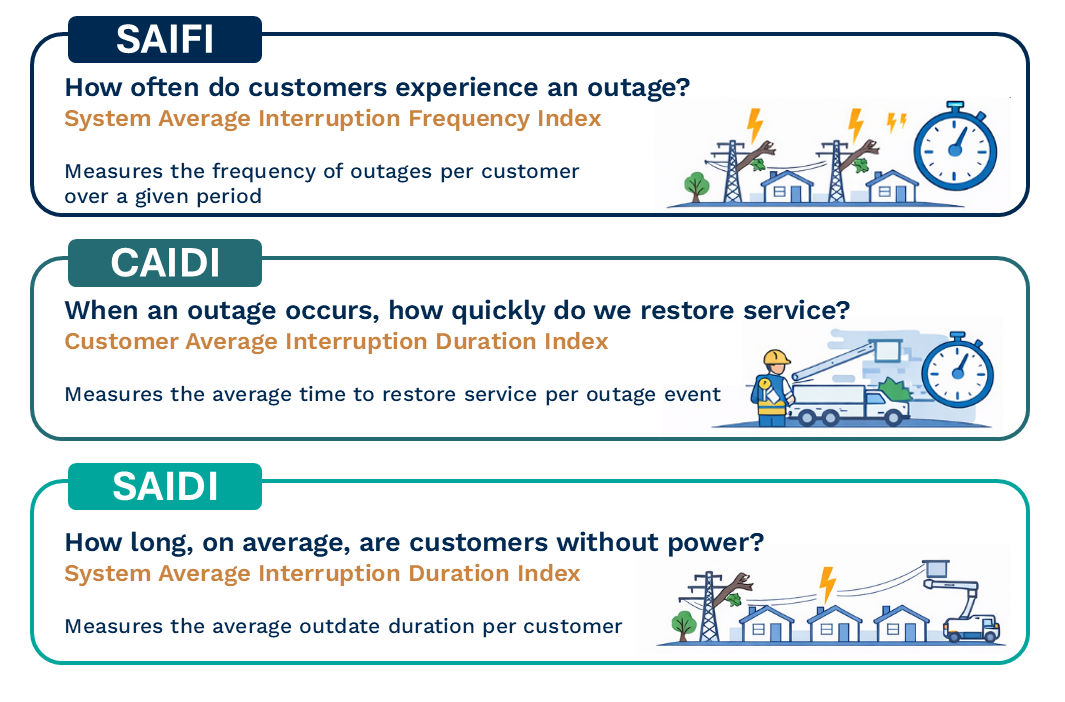
- SAIFI: Measures the frequency of outages. It answers: How often do customers experience an outage, helping identify recurring issues with equipment, vegetation, or system design?
- CAIDI: Measures the average time to restore service per outage event. It answers: When an outage occurs, how quickly do we restore service?
- SAIDI: Measures the average outage duration for all customers over a given period. It answers: How long, on average, are customers without power in a year?
All three metrics are essential for regulatory compliance and customer satisfaction. High SAIFI means customers experience outages too frequently. High CAIDI indicates slow restoration per event, while high SAIDI means customers experience long outages overall. Utilities strive to keep all three as low as possible.
National Averages (Excluding Major Event Days)
According to the U.S. Energy Information Administration (EIA), national average reliability metrics (excluding major events) for the U.S. distribution system were:
- SAIFI: 1.5 outages per customer in 2024.
- CAIDI: 131.6 minutes in 2024.
- SAIDI: 123.6 minutes in 2024.
For more detailed data, the U.S. Energy Information Administration (EIA) website provides annual reliability metrics at a national and state level.
Challenges in Improving Reliability
Utilities face several hurdles:
- Aging Infrastructure: Equipment nearing end-of-life increases risk of failure.
- Manual Processes: Paper-based workflows or inadequate and outdated mobile systems slow down outage responses.
- Limited Visibility: Disconnected systems — including dispatch schedules, work orders, technician assignments, and billing or outage data — make it difficult to prioritize maintenance and allocate resources efficiently.
The Role of Asset Lifecycle Management (ALM)
Improving SAIFI, CAIDI, and SAIDI starts with better asset management. Capturing detailed maintenance and downtime data in tools like MAS Manage allows utilities to see how individual asset performance contributes to the overall reliability that customers experience. Proactive maintenance, real-time monitoring, and integrated work management not only reduce outage frequency and duration but also provide visibility into the direct impact of field activities on system-level metrics. Achieving this requires a software solution that unifies data, predicts failures, and optimizes response—enter IBM Maximo Application Suite.
How IBM Maximo Helps Improve CAIDI, SAIDI and SAIFI
IBM Maximo Application Suite offers a comprehensive platform for asset performance and reliability. Here’s how it makes a difference:
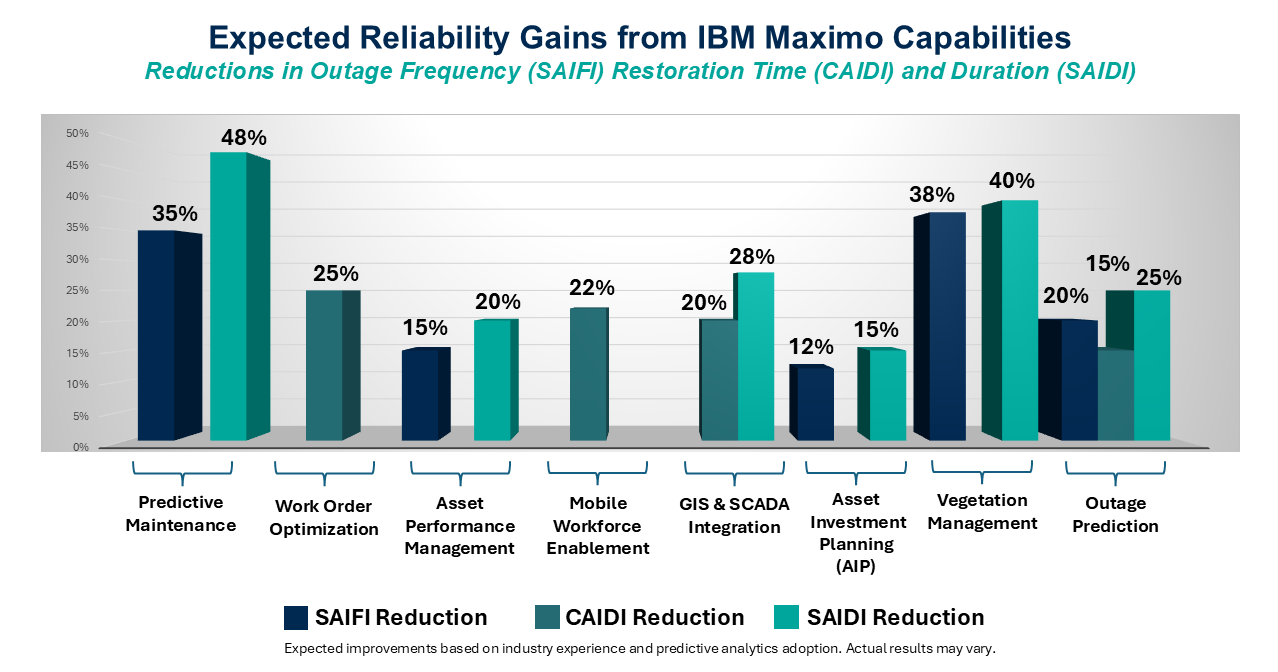
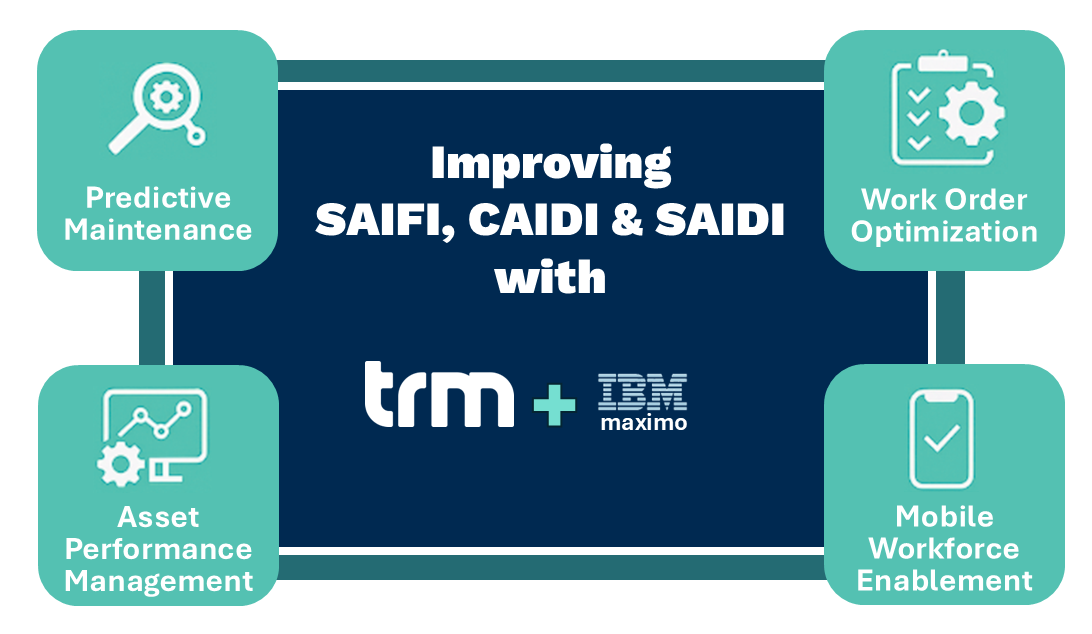
1. Predictive Maintenance
Leveraging Maximo Monitor to ingest IoT sensor data and apply AI analytics, Maximo can predict equipment failures before they occur. This enables utilities to address issues proactively, reducing unplanned outages, and improving reliability metrics such as SAIFI and SAIDI.
2. Work Order Optimization
During outages and maintenance events, Maximo automates work order creation, prioritization, and scheduling. Optimization capabilities ensure crews are dispatched quickly with the right skills, tools, and information, improving response time and lowering CAIDI.
3. Asset Performance Management
Maximo continuously tracks asset condition, performance, and lifecycle costs. By identifying high-risk or underperforming assets, utilities can prioritize maintenance and replacement strategies that strengthen grid reliability.
4. Mobile Workforce Enablement
Field technicians access real-time asset data, work instructions, and reporting capabilities through Maximo Mobile. This improves crew productivity, accelerates restoration activities, and reduces outage duration.
5. Integration with GIS and SCADA
Maximo integrates with Geographic Information Systems (GIS) and Supervisory Control and Data Acquisition (SCADA) platforms to provide real-time operational awareness. This integration allows utilities to quickly locate affected assets and make faster, more informed decisions during outage events.
6. Asset Investment Planning (AIP)
Maximo Asset Investment Planning applies AI-driven analytics to optimize long-term capital investments. Utilities can evaluate risk, performance, and cost scenarios to align budgets with reliability objectives and reduce SAIDI, SAIFI, and CAIDI over time.
7. Maximo Vegetation Management
Maximo Vegetation Management uses satellite imagery, LiDAR, and AI-powered analytics to identify vegetation encroachment risks along transmission and distribution corridors. Utilities can proactively prioritize trimming activities and generate targeted work orders, reducing vegetation-related outages and improving reliability metrics such as SAIDI and SAIFI.
8. Outage Prediction for Grid Resiliency
IBM Outage Prediction leverages advanced weather forecasting, historical outage data, and AI analytics to anticipate the impact of storms and extreme weather events on the grid. Utilities can proactively allocate crews, pre-stage resources, and prioritize high-risk areas before outages occur. By improving preparation and response, this capability helps reduce outage frequency, minimize restoration times, and strengthen reliability metrics such as SAIFI, CAIDI, and SAIDI.
Real-World Impact
A major regional utility has launched a Five-Year Reliability Program to improve the everyday reliability customer’s experience. By combining $1.3 billion in grid investments with modern digital tools like the Maximo Application Suite, the utility is working to reduce both how often outages occur and how long they last.
Today, the five-year average SAIDI is about 5.10 hours of outage time per customer each year. The program aims to reduce that by 20 percent, bringing the average down to roughly 4 hours per year—meaning customers could experience more than an hour less downtime annually. The plan also targets a SAIFI level of 2.05 outages per customer per year, reducing how often interruptions occur.
TRM helped enable this transformation by upgrading the utility’s Maximo platform and integrating key operational systems—including GIS, ADMS, and field service tools—within TRM’s cloud environment. With better visibility into asset performance, the utility can identify risks earlier, such as transformers that may be approaching failure, and address them proactively before they cause outages. When outages do occur, improved workflows and mobile tools help crews respond faster and restore power more efficiently.
For customers across the service area, the result is simple but meaningful: fewer outages, shorter interruptions, and a more reliable power grid.
By modernizing the IBM Maximo environment and integrating critical operational systems, TRM has helped the utility advance its Five-Year Reliability goals. Predictive maintenance identifies at-risk assets before failures occur, reducing SAIFI, while mobile-enabled crews and optimized workflows help restore service faster, lowering CAIDI. Together, these improvements reduce SAIDI, resulting in a more reliable grid and a better experience for customers—fewer interruptions, shorter downtime, and a stronger, more resilient electricity system for years to come.
Why Partner with TRM?
Technology alone isn’t enough—successful outcomes require expertise in implementation, integration, and optimization. That’s where TRM comes in:
- Authorized Platinum IBM Maximo Provider: TRM delivers the full IBM Maximo Application Suite, tailored for utilities.
- Industry Expertise: With decades of experience in Energy and Utilities, TRM understands the unique challenges of reliability and compliance.
- End-to-End Services: From system design and deployment to training and ongoing support, TRM ensures your Maximo investment delivers measurable improvements in CAIDI, SAIDI and SAIFI measures.
- MAS Hosting Services: TRM offers secure, scalable cloud hosting designed for asset-intensive organizations. Certified environments ensure uptime, reliability, and data protection while flexible configurations and expert support let your team focus on performance — not infrastructure.
- Proven Results: TRM has helped leading utilities streamline outage response, optimize asset performance, and achieve regulatory targets.
Learn more about our solutions for electric utilities on TRM Energy and Utilities page.
Conclusion
Improving SAIFI, CAIDI and SAIDI isn’t just about meeting regulatory targets—it’s about delivering reliable service and building customer trust. IBM Maximo empowers utilities to move from reactive firefighting to proactive reliability management, and TRM provides the expertise to make it happen.
Request a consultation to learn how we can help your organization achieve reliability and resilience.
Ready to elevate your asset management?
Connect with TRM to start your journey toward exceptional performance.
Related Resources
Explore insights, guides, and tools designed to help you unlock greater asset management performance and business value.


Unlock smarter
asset management
Ready to elevate your asset management?
Connect with TRM to start your journey toward
exceptional performance.