Drowning in MRO Inventory? How to Regain Control

Dan Moss
Senior VP Consulting Operations TRM
May 3, 2026
Two Competing Perspectives
There is often tension between two competing needs within a business. On one hand, maintaining assets and ensuring high equipment availability requires ready access to the parts needed for maintenance. On the other hand, the capital tied up in MRO inventory is a recurring cost that must be effectively managed.
For those responsible for achieving the maximum equipment availability, having spare parts readily available and immediately accessible is highly desired. For those primarily focused on the financial performance, MRO inventory represents recurring costs such as taxes and insurance—as well as capital that could potentially be used elsewhere in the business. Both views are valid, and each must understand and respect the priorities of the other.
The good news is that there does not need to be a compromise. There simply needs to be the application of Best Practices, so the optimal MRO Inventory can be achieved, which supports both perspectives: operational reliability while also meeting financial objectives. The following overview provides the perspective that leadership must embrace and then be supported with a disciplined and well-defined path required to achieve the Right-Sized MRO Inventory.
Best in Class MRO Inventory
Studies conducted across the full spectrum of businesses comparing MRO inventory levels reveal that the best performers achieve and maintain an MRO inventory value that ranges from 1% to 2% of the asset replacement value (RAV). This inventory value is achievable while at the same time realizing the highest equipment availability and service levels amongst their peers. For asset-light businesses, the MRO inventory levels are in the 1% of RAV range and sometimes even lower. For asset-intensive businesses, the MRO inventory levels tend to be at the higher end of that range, 1.5% to 2%. This is at least partly due to high dollar insurance spares.
The key—and this is critical to achieving the dual objectives of high equipment availability and low MRO inventory value—is to consistent application of Best Practices in Work Management, MRO Stores, and reliability processes. When a business understands and follows the industry best practices across these three areas, they are the most effective and efficient in meeting equipment needs and managing their MRO spend and inventory.
Caution Warranted
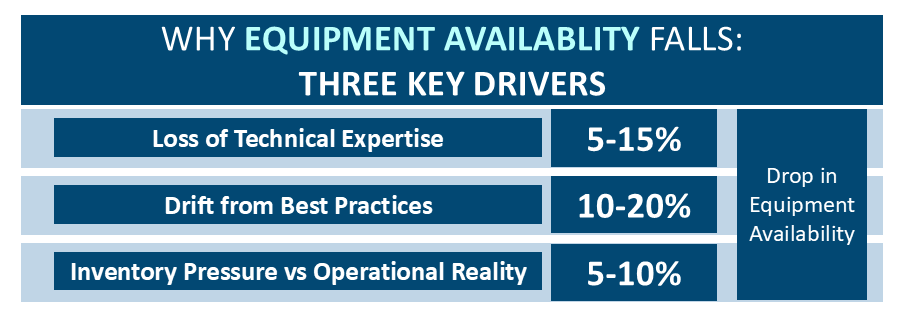
Major caution here is warranted. We are frequently called upon to help a client that has seen a decrease in their equipment availability over time. There are three common causes:
The first is heavy reliance upon the technical expertise of seasoned employees who have retired. Sometimes it is a few key individuals, or, in many cases, a large number of experienced employees walk out the door with relative inexperience taking their place.
The second is particularly unfortunate: a plant that once understood and practiced the best practices in Work Management, MRO Stores, and Reliability drifts away from them. This most often occurs when leadership changes, and the new leaders do not fully understand the value created by adhering to industry best practices. We have even heard the comments such as, “We’re running so well—why do we need so much maintenance and so many spare parts?”
Without recognizing that these strong results are the direct outcome of disciplined best practices; decisions are made that slowly dismantle the very processes responsible for success. Because the negative consequences often take time to surface, the leaders who made those poor decisions have frequently moved on before the full impact is felt.
The third cause that decreases equipment availability relates to the tension mentioned at the outset. “We have too much money tied up in our MRO inventory, and we can see that our competitors run with less inventory. Therefore, we need to cut inventory to be like them.” Without the support of the best practices, such an exercise becomes self-defeating over time, heading to a downward spiral that is hard to reverse.
Path to Right-sized MRO Inventory
Both a ballooned MRO inventory and sub-optimal equipment availability are the cumulative result of practices and processes that are less than the best practices. There has been much work performed over the past two generations capturing, analyzing, and documenting what works and what doesn’t. Best Practices are not a secret. In fact, they are common sense solutions that simply are not common enough. The key is to gain an appreciation for and an understanding of Best Practices at the leadership levels of the organization. From this point, a comprehensive plan to implement and sustain these best practices can be identified and put in place. Once the best practices have been rolled out, an intentional plan to support and sustain them must be established.
Achieving the right size MRO Inventory level is a moving target. In the highly reactive state where we find most plants requesting help, the inventory will necessarily be elevated to provide rapid response to the large volume of emergency and urgent, corrective repairs. It is unacceptable for critical equipment to remain down simply because the choice was made not to stock a part in the storeroom. Likewise, it is not acceptable to have a lot of emergency corrective repairs where proper maintenance and reliability practices are able to prevent, predict, or mitigate equipment failures. Both of these situations are addressed through the application of Work Management, Stores, and Reliability best practices.
It must be noted that simply addressing one area will not provide full results if the best practices in one of the other two areas are deficient. Each of the three areas provides a crucial element in the overall strategy that allows for optimal equipment performance at the lowest sustainable costs in both direct maintenance spend and MRO Stores inventory.
Work Management best practices improve efficiency across all maintenance activities, including corrective repairs, preventive maintenance, and the forward-looking predictive maintenance efforts. Work Management ensures that the entire team responsible for operating and maintaining equipment performs their work in a manner that maximizes the reliability, performance, and overall life of the plant or facility.
MRO Stores Best Practices ensure that when repairs are performed, they are done with the correct part, in the proper condition, at the time of need, at the best price. These Best Practices support the transition from higher to lower on-hand MRO inventory levels that do not increase risk. They allow adjustments from when the plant is highly reactive and needs a lot of parts promptly through to the optimal inventory levels when the plant is highly reliable, and issues are identified early enough that they don’t need to be in stock.
Finally, Reliability Best Practices identify where to focus efforts and the steps necessary to become more proactive and less reactive. Establishing a comprehensive and robust Asset Care Strategy is predicated upon the understanding and implementation of the Reliability best practices. A roper Asset Care Strategy enables the Work Management and MRO Stores best practices to achieve their intended benefits.
A Glimpse into the MRO Inventory Weeds
MRO Inventory levels are determined by what is needed in a relatively prompt manner for the sustained performance of the plant equipment. While there are several variables that come into play, the decision process is relatively straightforward. If the cost for holding and servicing the part in inventory is more than the financial impact of not having the part immediately available, then the part should not be kept in inventory.
The cost to carry and service the MRO inventory is typically the easier side of the equation to calculate. However, the true cost extends beyond the original purchase price of the part. This is an area where the maintenance team should at least have a general awareness.
MRO inventory carrying costs can range anywhere from 10% to 40% of the original purchase price, depending on factors such as local taxes, insurance, and financial accounting practices. The fact that these are recurring costs is often underappreciated by the Operations and Maintenance teams.
The financial impact of not carrying the part in stock is more difficult to consistently calculate. It is also the area that will be significantly impacted by adherence to the best practices in Work Management and Reliability. Extending equipment life and giving early indications of upcoming corrective repairs allows the plant to run with lower on-hand inventory levels and, in some cases, move to ordering the parts when a need is identified rather than having the parts in stock. As the plant moves from reactive to proactive by following best practices, MRO inventory levels can be gradually reduced.

Life in the Weeds – Leveraging Your EAM System
Today’s leading EAM Systems can greatly simplify the calculations related to what to stock, how much to stock, and all other aspects of MRO Inventory decision-making. Artificial intelligence capabilities within the leading systems can analyze large volumes of data in a fraction of the time required by older systems and manual processes. In organizations where deeply experienced employees have retired and been replaced by newer, less experienced personnel, these systems can support sound decision making while accelerating employee development by providing both valuable information and guidance in how to interpret and use it effectively.
When properly aligned, the EAM system becomes more than a maintenance database—it becomes the operational foundation that connects Work Management, MRO Stores, Reliability, and inventory optimization into a unified business process.
There are several key considerations required for this to become a reality. First, the EAM system must be properly implemented and configured in support of the Work Management, MRO Stores, and Reliability best practices. Second, personnel must be properly trained and coached in the effective use of the EAM system. Third, the EAM system must become the primary source for data input and information retrieval related to equipment and MRO inventory. Finally, disciplined and consistent use of the EAM must be practiced throughout the organization.
Organizations that combine strong EAM practices with structured MRO inventory management are better positioned to improve equipment availability while reducing unnecessary inventory investment.
Commitment and Timing
Hopefully it’s becoming clear that right-sizing the MRO Inventory is less of a stand-alone project and more of an integrated component in an overall Asset Management Strategy. While there are significant tasks that can be accomplished within the MRO organization itself, even those efforts have connections to the broader plant team.
One essential step is identifying ALL spare parts available throughout the plant and ensuring they are entered into the EAM or CMMS, so they are visible and accessible to the maintainers who may need them. (And YES, that includes all the parts hidden away in the field for those “just in case I might need it” situations.) Another important step is streamlining the internal and external lead times so that non-stocked parts can be procured and delivered in a timely manner when needed. These are just two of the many activities required to begin moving toward a right-sized MRO inventory.
The majority of the tasks required to right-size the MRO inventory depend heavily on input and participation from groups outside the traditional MRO procurement and storeroom functions. As a result, success requires a high degree of coordination, teamwork, and shared understanding across the organization. The journey is holistic in nature. When executed correctly, an Asset Management Strategy built upon Best Practices delivers benefits far beyond lower MRO Inventory carrying costs. It positively impacts nearly every aspect of plant performance—safety, productivity, environmental stewardship, financial performance, morale, and even employee retention.
The journey requires sustained commitment over time, but the results are well worth the effort. Instead of drowning in excess MRO Inventory, organizations can find themselves swimming in a sea of satisfaction, operating with confidence, control and a level of performance they have always aspired to.
TRM works with clients to bridge the gap between having systems and data in place and actually using them consistently to drive better Asset Management and MRO inventory decisions.
Contact TRM to assess the underlying drivers of MRO inventory performance in your operation and identify where improvements in Work Management, Reliability, and Stores discipline can safely reduce inventory while maintaining or improving equipment reliability
Contact us at TRM or email us at askTRM@trmgroup.com.
Follow Dan Moss on LinkedIn for proven strategies and practical guidance in reliability and asset performance management.
Ready to elevate your asset management?
Connect with TRM to start your journey toward exceptional performance.
Related Resources
Explore insights, guides, and tools designed to help you unlock greater asset management performance and business value.


Unlock smarter
asset management
Ready to elevate your asset management?
Connect with TRM to start your journey toward
exceptional performance.