Are You Ready for the Use of Prediction Tools?

John Q. Todd
Sr. Business Consultant/Product Researcher Total Resource Management (TRM), Inc.
With all the hype and hubbub about predictions these days, it makes sense to take a step back and see if you and your organization are ready to start the journey. You may find that you have all the pieces in place, just not well organized for ease of use. Or you may find that there are many things you need to put into place well before you can even think about trying to “predict,” anything.
Let’s start with data…
Does the following look familiar to you?

If this dataset is as familiar to you as your Angry Birds score progression, then you are in a good position to begin your prediction journey. If your eyes have already glazed over as they do when preparing for the next years’ budget wars, then you might need to do some learning.
To let you off the hook a bit, what you are looking at is a list of vibration sensor values that have been captured every 15 minutes from a specific sensor (the tag) attached to a specific location on an operational compressor.
Self-Assessment
Let’s get right into the questions you need to ask yourself to see how well positioned your organization is to take advantage of prediction tools. The goal is to have answered “Yes” more times than “No.” The more Yes, the better the position you are in.
The questions where you indicated “No” can be areas where you can investigate further and turn them into at least a “Yes, in progress” as you begin your journey to prediction.
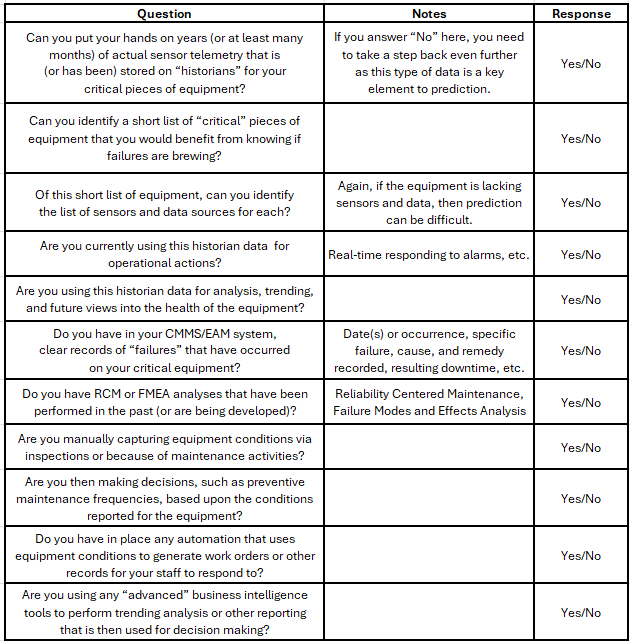
If you answered Yes more often than No, then you are in a good position to begin looking into the use of prediction tools. Even if your results are around 50/50, you still might have the foundation needed to start looking at solutions and perhaps doing a few proofs-of-concept.
So, what are “prediction tools,” anyway?
There are many software solutions on the market and each one has its forte. Some tools are designed specifically to perform predictions, while others are embedding this function into existing solutions. There is a new language to learn for sure. Terms such as tags, anomalies, Jupyter Notebooks, model training, algorithms, etc. are not in our daily maintenance management vernacular. Yes, this is a new world to learn about.
In general, these tools ingest many months, or even years of discrete data that has been captured from sensors on equipment. At the beginning of this article, the example data provided was from a vibration sensor attached to a compressor that was providing a reading every 15 minutes for several years. Being a vibration reading, the units are in inches per second. This data is used to train a machine learning model for what is “normal,” and to look for developing failures. Real time data from the same sources is then used by the models to alert to what they were trained to look for.
Let’s assume that there are several other sensors attached to the compressor… perhaps a run hour, or RPM, or temperature, perhaps even output pressure, the list could go on. All this data has hidden within it trends, anomalies, and even failure patterns that are not readily apparent with traditional spreadsheets or reporting approaches. No, you need something more sophisticated than that.
Let’s not forget the lowly CMMS/EAM system where your field staff has been dutifully documenting the failures of the equipment over time. As you look at using prediction tools, it becomes obvious that you will want some validation of what the prediction tool is telling you. The more evolved prediction tools can not only connect to your historians for learning and processing, but they can also connect to your CMMS/EAM system for actual failure history.
Combining the two sources of data: the telemetry from the equipment and the human captured failure instances, makes for a very accurate picture of the past as well as the future of your equipment. Those human recorded failures can lie on top of what the prediction models have learned. The model shows a high probability that a failure was trending, that occurred in the past, and the work order(s) from the field confirms it. Very powerful stuff!
How to get started?
Put the need for data aside for a moment and consider your equipment. As one of the self-assessment questions asked, can you identify a set of equipment that is critical to your operations? If this equipment is not available for production, the financial losses or even safety concerns are significant. It is this set of equipment where being able to predict anomalies and developing failures should be your initial focus. It is not wise to just “predict on everything.” No, you need to focus on that equipment where downtime is costly.
Once you have this list of equipment in mind, then go looking for the kinds of data we have described. The first is of course the moment-by-moment telemetry coming from the equipment. This data might already be well known by your Operations staff as they respond to alarms and other notifications.
The other important source of data as we mentioned is in your CMMS/EAM where actual failures, causes, and remedies have been captured over time by your highly experienced field staff. There is true gold in this data. It is not just icing on the cake. If you find the capture of this level of data lacking, it might be a good first step to start (or restart) efforts to diligently capture this data and begin to use it for analysis and decision making. This data on its own can be very useful and well worth the effort!
Wrap up
Hardware and software technology has evolved to a point where we can understand the health and impending doom that our equipment is experiencing, not only in real-time, but also well into the future. Failures can be predicted and planned for. Let’s work to greatly reduce the number of call-ins at 2 AM, shall we?
TRM and IDCON have been working with clients across industries for many years to make sense of their business process and technical data. We represent a set of prediction solutions that we believe are the best on the market. IBM MAS Predict and Aspen Mtell. Both have their strengths and applicability to your operations and scope of equipment.
Ready to elevate your asset management?
Connect with TRM to start your journey toward exceptional performance.
Related Resources
Explore insights, guides, and tools designed to help you unlock greater asset management performance and business value.


Unlock smarter
asset management
Ready to elevate your asset management?
Connect with TRM to start your journey toward
exceptional performance.