Convincing Decision-Makers to Invest in an EAM Solution

John Q. Todd
Sr. Business Consultant/Product Researcher Total Resource Management (TRM), Inc.
Back in the day, me and my team of reliability engineers decided that we needed dual monitors for our workstations. We also believed that it was not fair that only the IT staff were allowed to have such a luxury. Everyone “knew” that having double the screen real estate made a huge difference in our efficiency at pawing through volumes of data. Management wanted proof. Never tell a group of reliability engineers that you need proof!
In the end, the time-motion studies of both our team and that of the IT staff and references to academic studies, all presented in a series of succinct slides, including videos of actual users with a single screen vs. dual, were incontrovertible and we got our dual monitors. (And bigger screen sizes than those in IT!)

System Security Specialist Working at System Control Center. Room is Full of Screens Displaying Various Information.
The point is that management has the duty to ask for clear information and insight to make decisions. This is their job: Make decisions based upon what is known at the time. It is your job to provide this valuable information.
Convincing decision-makers to invest in an EAM solution
Even if a CMMS/EAM/APM solution is already in place yet it is time for something new, or if there is nothing of the sort in play, there is an investment to be made. Implementing solutions across the enterprise or even those with a narrower focus does cost money that might not be in this year’s budget. The range of implementation costs can start as low as $50,000 and easily go into the many millions of dollars depending on the scope, needed functionality, number of users, complexity, and so on. Given the significant cost in any business context, there is an expectation of a return on the investment over a reasonable period.
Put aside for a moment the initial cost of the solution implementation. Rather, focus on how, how much, and where the solution must tangibly benefit the organization. Beyond just having a new tool with real-time charts and graphs to play with… where are the real benefits and how can they be quantified?
Implementing a solution is not a one and done activity. While the initial implementation may be a singular large project, this is only the beginning. The real value of solutions such as these is in their flexibility and growth potential as the organization evolves over time. Yes, the solution does provide efficiency and organization out of the box, but it also comes with tools and techniques that when pressed into service can have a dramatic impact on the manual labor needed to maintain business records. Workflows, work queues, communication automation, on-screen help checklists, and behind the scenes business rules are all commonly available tools that help the organization form the solution over time into their needs.
While percentages and amounts of savings an organization can expect are all over the map and can be argued, what is important are the areas of operation that can benefit that might not be an obvious consideration. Areas such as (with anticipated benefits):
- Equipment utilization – up by 3-5%
- Warranty recoveries – up by 10 – 50%
- Inventory carrying costs – down by 5 – 20%
- Material costs – down by 5 – 20%
- Mean time to Repair (MTTR) – down by 20%
- Purchasing staff labor costs – down by 10 – 50%
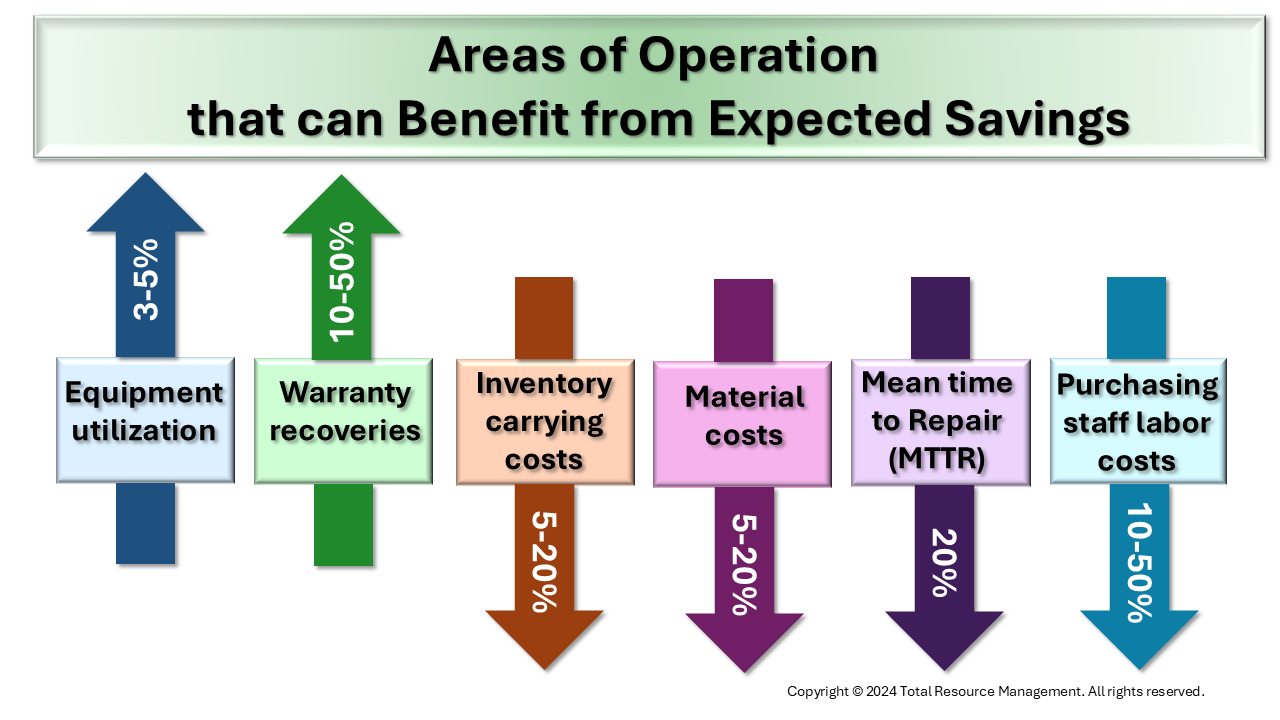
In some contexts, the percentage savings would be a drop in the bucket and not worth the time to investigate. However, in many cases, these percentages can reflect hundreds of thousands, if not into the millions of dollars of benefits for the organization. Further, it may be difficult to quantify some areas of benefit due to the lack of captured data. A good example of this is the potential savings around purchasing staff labor. Unless one does a time-motion study on how purchase requests are processed, capturing before and after data, it may be difficult to see the benefit other than anecdotally that things “seem better.”
There is a cost to less than stellar operations
Deloitte makes the statement that poor asset management practices are known to erode production capabilities by 5-20%, which in turn can have an impact on revenue. Events such as unplanned maintenance can be related to poor practices. As much as a 30% reduction in unplanned maintenance has been attributed to the implementation of a CMMS/EAM system and interfacing it with an ERP system. Every moment of downtime or lack of production is costly.

It is obvious that being more efficient at addressing the issues of the day can reduce costs, but what if those issues can be eliminated or better planned for? There can be real value in being able to plan for not only developing issues, but also preventive activities.
The questions are:
- What organizational goals will be more easily achieved by this implementation?
- Is there a focus on increases in revenue? Is cost reduction more of a priority for profitability?
- Is lengthening the lifetime of assets important?
Or does getting a few more percentage points of performance out of the production lines have the most value? Maybe the organization simply needs to become more efficient at what they do.
It is true that a CMMS/EAM/APM system can help in all these areas, but the business case needs to fall in line with these elements and have an obvious needle moving impact or it will be ignored by management.
Three steps: Quantify, Relate, then Shop (and buy!)
A CMMS/EAM/APM system has a singular forte’: It is the source of truth of information/data for many roles across the organization, of which is presented or communicated clearly to the users for them to take proper action as a result.
Challenge: Quantify the benefit of a CMMS/EAM/APM solution to the organization in terms that will resonate with the boss’ boss.
Consider the first argument to quantify is that of efficiency or time savings of staff via the use of the solution. It is a given that it takes far less time to click/press the way through a process than it does making phone calls, sending emails and forgive the thought, having to go talk to someone!
By having the business process(es) built into the solution, from the beginning to the end, the process is performed within the solution. The solution plays key roles along the way of the process. When a record meets certain criteria, a notice is sent out for a person to act. Or, even better, the record that needs attention is placed right in front of them on the screen.
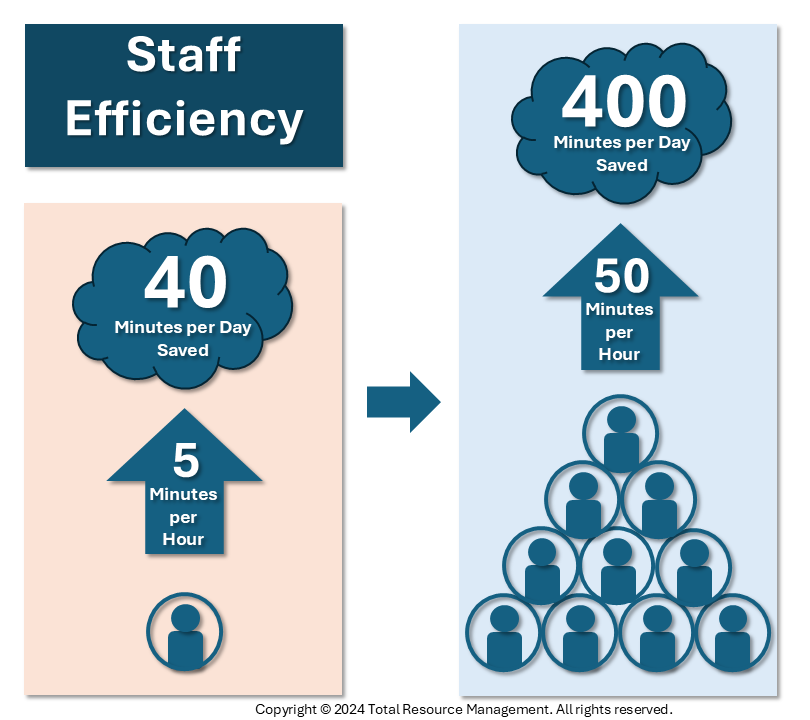 If the solution saves a person 5 minutes per hour, that’s 40 minutes in an 8-hour shift. If the entire team of 10 people experiences this time savings, then in one day 400 minutes can be saved. Numbers like this are not unreasonable… vast amounts of time are wasted trying to find information about the work at hand, moving records to the next lifecycle step, filing paperwork, communicating, etc.
A quick survey of the work force about the amount of time they spend on “paperwork” can be eye opening. Even the folks out in the field can benefit via the availability of mobile devices. More on that later.
Briefly mentioned is the next area to quantify – availability and access to the information needed to get work done. Large amounts of time are also wasted while trying to find out what is needed to execute work orders. For example:
- Positively identifying the asset (equipment) that is to be worked on
- Safety requirements in the context of the equipment and the work to be performed
- Operational status(es) of the equipment that allow work to be performed
- Locating the equipment
- Clearly understanding the work to be performed
- Tools needed to perform the work
- Spare Parts and/or consumables that will be needed
- Required documentation/data to capture
- Clean up and disposal requirements

The above list could go on, but the idea here is that every and any moment wasted chasing any of these things down can add up quickly.
CMMS/EAM/APM solutions can provide all this information at the fingertips of not only the desktop user, but those folks out in the field as well. Attached documents, locations, addresses, maps, real-time status indicators, spare parts/BOM lists, inventory levels, etc. are just a few examples of the information that can be accessed from within these solutions.
While it may seem silly, find a few willing participants to allow you to time them while they are trying to find information. Again, this may be just a few minutes per hour, but it will add up quickly for larger teams.
Given that executing and documenting business processes and finding information will always take time out of the workday, anything that can be done to reduce this wasted time has great value. Take the numbers you come up with and translate them into potential $ savings over 1–2-year period. They will be substantial!
These time savings can also be directly related to equipment downtime and other interruptions in production. Every minute saved trying to find information is one more minute of up time for the equipment. While minutes may not seem like much, over a year period they add up and translate to potentially millions of dollars in production and the resulting revenue.
An often-forgotten area of improvement that a modern CMMS/EAM brings efficiency to is the area of inventory management. Maintaining equipment requires spare parts, consumables, and a host of other materials that need to be planned for, purchased, inventories, then dispatched. Visibility is needed as to the availability of materials not only for the field staff, but also the inventory/purchasing staff who support them.
Parts being out of stock, long lead times, and even manufacturers going out of business all can cause sustained downtime for the equipment, having a great impact on production. We have all seen partially opened equipment sitting on the floor with tags stating, “Waiting for parts.”
Quantifying the cost(s) of this downtime due to unavailable parts in the areas of production, revenue, or even profit can be a valuable argument to adopting a modern CMMS/EAM system. This is not to start a blame game between maintenance and purchasing, but rather be able to quantify the cost, again due to unavailable parts, to the organization.
In the end of the quantification, it should be clear how the CMMS/EAM solution will return on the investment:
- Efficiency gains in both labor and administrative time
- Cost savings via reduced reactive maintenance and inventory holding/processing
- Increased equipment lifespan and/or performance
Relate business goals and processes to a solution
The quest for an EAM solution must align with the current horizon of business goals. As the business looks forward 3-5 years, which goals could be positively impacted by the implementation of an EAM system? Hiding in many goals is the notion of “financial optimization,” where the supporting elements of the goal (equipment, people, etc.) are operating at maximum financial capabilities. If a focused goal is to increase production capability, in support of that goal, the required equipment must be available and operating at levels to not impede the new production goals.
An EAM system will assist those responsible for the maintenance of the equipment to strategize how to define tasks and approaches to ensure their efforts are in support of the business goals.
Business processes can be as simple as filling in a form and handing it to a person to perform the next step. They can be as complex as commissioning a new type of equipment on the production floor. No matter the complexity, a CMMS/EAM solution exists in part to foster the execution of business processes nearly 100% electronically. It is the mapping of the current business processes to the solution that is a key step in the rationalization process.
There is hardly a business process that cannot be impressed into a CMMS/EAM solution. In fact, most solutions have built-in processes that can replace (perhaps with some refinement) a significant percentage of the current processes. The goal with this step is to map the current process to one that is either already in the solution or could be.
For example: Purchasing and fulfillment. It is reasonable to consider that the entire Purchasing process for most organizations can be fully electronic. Beginning with the original request (even that could come from an automated process), through the selection of a supplier, all approvals, the transmission of the order to the supplier, receipt, warehousing, and the final issuance of the material to the work crew.
With a fully electronic process such as just described, all the milestones (dates/times), approval levels, statuses, etc. are largely auto generated and clearly visible to all involved.
The important step is to define the business processes that are envisioned to be largely operated within the CMMS/EAM, and the supporting processes that might be able to be brought into the new solution or may need to stay where they are for now. In general, one can organize work processes into the following:
- Asset management
- Work management
- Production management
- Purchasing management
- Inventory management
These are large categories, each of which could contain many defined processes depending upon the scope of the organization. If the organization is ISO 900x, CMMI, or the like registered, the Quality Management System (QMS) is an excellent place to begin to find documented processes. Short of that, consider the CMMS/EAM system will be the hub of nearly all processes within the organization and work from there.
With focus on Work management, some of the tactical processes that could exist are:
- Work identification
- Work prioritization
- Work approval
- Work planning
- Work scheduling
- Work execution
- Work completion/documentation
- Backlog management
- Work analysis
Mapping the degree that each process… with hopes that it will be 100%… can be executed within the CMMS/EAM solution is the next step. There will be points in any process where automation may not be possible, but that is acceptable if most of the process can be contained in the solution.
Keep in mind that modern CMMS/EAM systems are routinely interconnected with other business systems. These interfaces may largely be invisible to the users. They simply see the data they need to perform their function, not needing to know where it came from. If a process spans multiple disciplines within an organization, these interfaces may need to be considered. In these cases, the CMMS/EAM solution may play only a partial role in the end-to-end process.
At the end of this step in the journey, there is a long, but clear, list of requirements that the organization has for the new CMMS/EAM system. The process areas are clearly defined and within each area process diagrams, use cases, personas, etc. are available for the team to use as a foundation for the next step… finding a solution.
Time to go shopping
Assuming that the boss’s boss is convinced by the data presented and their approval granted, the final step can begin. Do not begin this step until you have an agreeable sponsor who is in support of the project. They may be committing the organization to spend millions of dollars eventually, so their buy-in is critical well before any solution arrives at the door.
If the organization operates in a specific industry such as Utilities, Transportation, Pharmaceutical, Oil and Gas, or the like, seek out a solution and vendor who is experienced in the appropriate area. This is not to say that a vendor who is less experienced in the industry but is highly experienced in the solution implementation could not serve the organization well. Every organization believes they are “special,” but the reality is most business processes are 80—90% the same across organizations, so a solution nor the vendor needs to know “everything,” about the context of the organization. A vendor bringing robust process improvement or development accelerators to the project may be more valuable than one with deep and specific industry experience.
If, however, the industry is regulated, as with pharmaceuticals, the solution implementation will most likely require a validation process to satisfy agencies such as the FDA. In this case, the solution vendor having experience and tools to help with the validation will be helpful in ensuring success. Validation of a solution involves significant amounts of record keeping and documentation that begins well before the solution is implemented and allowed to be used.
A time-consuming element of the shopping task is matching the documented processes and requirements to the features/functions in a myriad of solutions. Recall stated earlier that most business processes are already reflected mostly in any CMMS/EAM system, so there will appear to be a good match on the surface. It will only be through demonstrations and perhaps even trial periods when the team can work on the solution before a good fit can be ascertained.
Attending local solution user groups is an excellent way to learn how other organizations leverage the solution. These gatherings may be sponsored by a vendor, but the presentations are largely performed by actual users of the solution. There you will hear about the good and the bad as they present their use cases and lessons learned. Larger conferences will have many more vendors to talk to, presentations to attend, and can be valuable as well for the comparison process. Case studies extolling extremely high ROI and other benefits, while interesting, should be looked upon as a range rather than a singular percentage to achieve. If a 30% decrease in maintenance costs is proffered, the reality might be more like 5% to 45% depending upon the nature of the operation and the solution itself.

Always consider staff training on not only the solution but also the “new” processes that may arise. In fact, “training” should start before the implementation project begins. By having multiple vendors in for demos and trial periods, and having staff attend these events and participate fully, those who will be most impacted by the solution will buy in from the very beginning. Remember, this may be a multiple year project, so these folks need to be with you for the long-haul. If done properly, by the time the solution is implemented, the staff will simply pick up its use immediately since they have been reasonably involved all along the way. Leave no one out, especially those on the process periphery!
Bringing this all together
With the benefits to the organization quantified, the business goals and processes defined and mapped to the solution, and the solutions weeded down to the top 2-3 candidates, now is the time to measure the expected benefits against the cost of implementation. If the calculations reveal that the organization can expect to save $1M over a three-year period due to process efficiency and increases in production, then what should the CMMS/EAM implementation cost?
As a side note, delaying the implementation of an EAM system simply pushes out the realization of benefits by that amount of time. If the business case is agreeable, it may have to wait for the next budget cycle if funds are not immediately available. If the delay is significant (6-12 months), then a degree of reanalysis might be in order in case the business goals or environment have a habit of changing that quickly.
Keep in mind that no savings will be made until after the solution is implemented. It will take some time for the impact of the new way of working to show up in quantifiable data. Consider the following:
- Solution takes 6 months to implement at a cost of $400,000
- Benefits are immediately apparent over the next 6 months in the amount of $250,000
- The next 6 months, the benefits slow down for an amount of $150,000
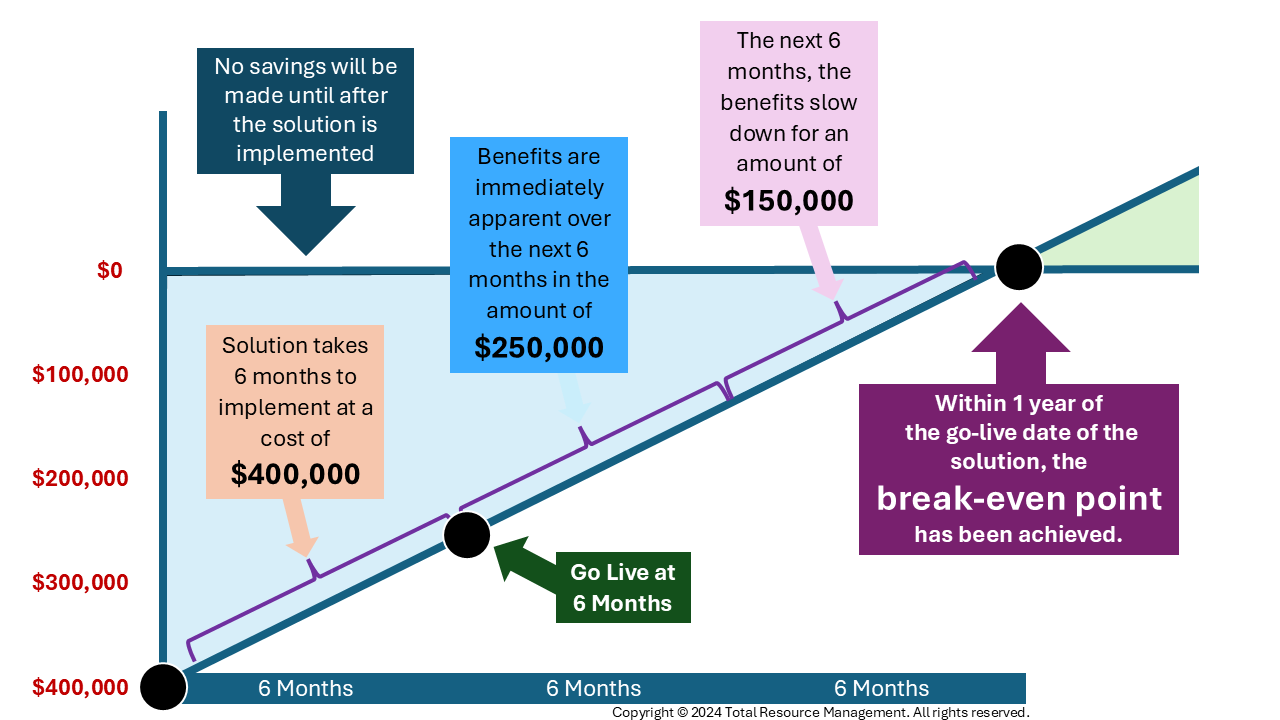
This shows that within 1 year of the go-live date of the solution, the break-even point has been achieved. What is important here is not the numbers but rather the observation (aka collection of data) that can be used to determine if the ROI for this project is truly panning out. External forces, such as changes in business practices or conditions can slow down the rate of ROI and frustrate the team. It may take a couple of years and a continual stream of refinements to see the growing ROI. Costs, over time, should be expected to reduce, while the benefits increase as time progresses. It is reasonable to assume that benefits will plateau after a few years as well. Be patient, collect data, adjust, remember what things were like before. Never forget to celebrate!
Wrap up
TRM has been assisting clients across industries for over 30 years in improving their processes and maximizing the use of their EAM solution. We have long-term relationships with our clients and have seen them take full advantage of tools such as IBM Maximo and SAP. Our consulting approach is focused on what the client wishes to accomplish, and we bring in solutions that match those goals, even if TRM is not the prime source of the solution. We have seen our clients reap the most ROI possible from CMMS/EAM solutions as well as help them make course corrections when business conditions change. Let’s talk about your goals and how we can help you convince the boss’s boss to invest in a solution that will serve the organization for many years.
Ready to elevate your asset management?
Connect with TRM to start your journey toward exceptional performance.
Related Resources
Explore insights, guides, and tools designed to help you unlock greater asset management performance and business value.

Unlock smarter
asset management
Ready to elevate your asset management?
Connect with TRM to start your journey toward
exceptional performance.