Generative AI’s Business Impact: A Guide for C-Suite Decision Makers

John Q. Todd
Sr. Business Consultant/Product Researcher Total Resource Management (TRM), Inc.
Let’s begin by putting “Generative AI” into the category of, “a shiny new object that looks as if it may have dramatic impact on a business, but not quite sure where or how yet.” New tools, techniques, and technologies arrive in our news feeds every day and Generative AI is no different. It is something new (becoming less so every day) that we need to consider how the business could benefit from its use.
Another way to look at Generative AI is how the competition may already be using it to their benefit. Clearly some early-adopter businesses have impressed Generative AI in their customer service, supply chain, and field support organizations. Significant reductions in manual tasks and increased staff efficiency have been realized across industries. While many of these examples come from very large enterprises, impacting 1000’s of staff members, the size of the business that can gain benefit from Generative AI is coming down every day.
Where to begin – Are we ready?
Put aside for the moment the notion of blindly jumping on board the AI movement and tossing aside the 5-year plan that was just approved. While these things may happen sooner than you believe, there is a critical element to have in place first: Is the business, namely the people who run it every day, agile enough to adopt tools such as Generative AI? Can the business pivot quickly (within 3-6 months) to adopt the use of new tools such as this and begin making the most of them?
Whenever a new or disruptive technology appears there is a small percentage of the workforce that easily adopts the new tool. These folks know the adoption of tools such as Generative AI will aid in not only their success but that of the business. Of course, there is a larger percentage who do everything possible to not use the tools, and in fact can be saboteurs. A far larger percentage of staff (thankfully!) will generally go along with the new approach and while they might not seem overly enthusiastic, in the end they appreciate the reduction in mundane tasks, giving them time for other activities. Therefore, it is not unreasonable to be “pushy,” when it comes to asking for new tools such as Generative AI to be adopted by the business.
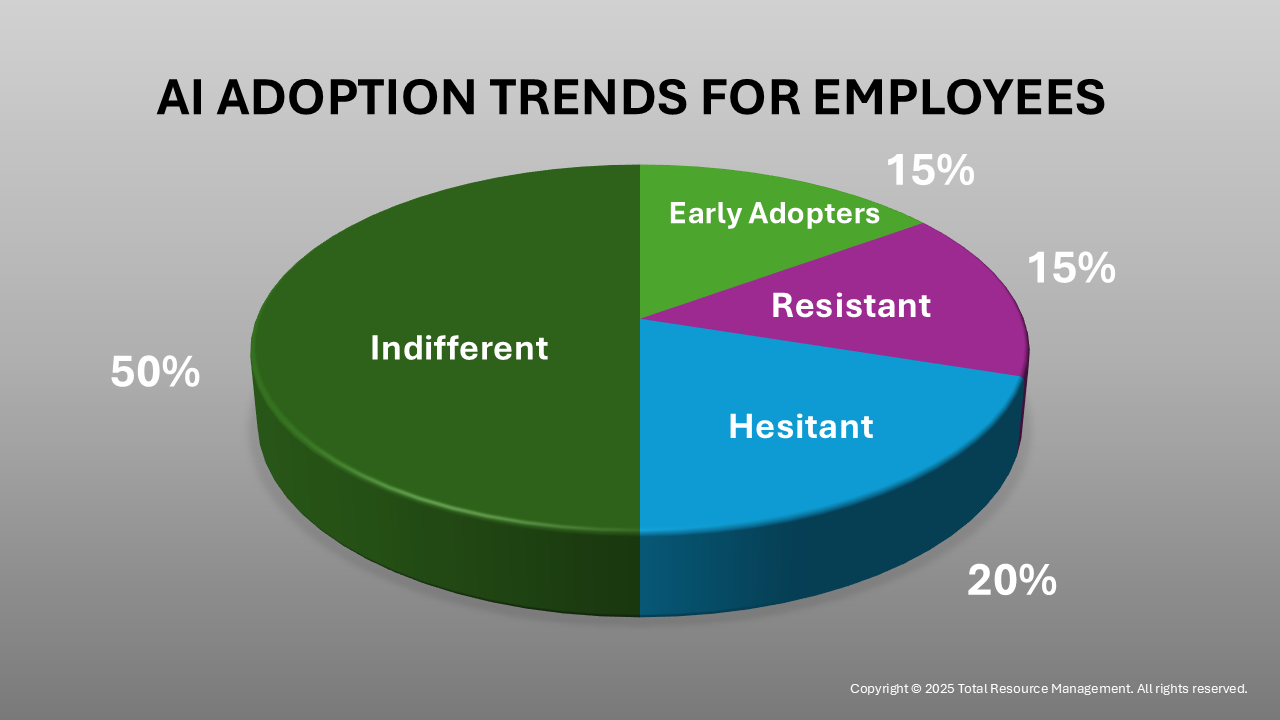
An honest assessment of the readiness of the organization for the changes such that Generative AI can bring is a necessary first step. Does the staff overall have the necessary skills to make the most out of the new tools? Does the business have an effective change management program in place to facilitate the changes? Is the business of a type that naturally can turn on a dime, or does it take years for even the smallest change to be implemented and show benefit?
Applicability
If a superficial look is taken, one may conclude that Generative AI is not very applicable to the current business. In the context of a steel mill, where and how AI could be used might not be very apparent. For a customer support center, the use of AI might be more obvious. For a utility or government facilities operation, the use of AI might have some interest, but security concerns may stand in the way.
Rather than focusing initially on where in the business AI could be used, the investigation needs to be focused on what the technology can do or has done for others, and then seeking out the internal opportunities.
Any organization that retains years of business data, from sales, production, fulfillment, maintenance, etc. has a gold mine of information that perhaps has untapped insights. In this data are trends and connections that only AI tools (or very sophisticated analysis tools) can bring to the surface. Given access to these sets of data, AI tools can learn and then process the information on demand, generating a variety of results for the user to choose which is the most useful to them.
One example is the generation (and maintenance) of regular business reports. Rather than having staff scramble around each month producing reports for upper management from a variety of sources, Generative AI can easily answer questions posed to the engine:
“Which regions are showing a slowdown in sales over the last 6 months?”
“Which warehouses have difficulty in fulfilling orders during the winter months and what are the common items they struggle keeping in stock?”
“Which production lines are the most cost effective and why?”
“Summarize the maintenance costs incurred over the last 3 years on our critical equipment list and relate it to replacement costs of new equipment.”
The list of potential questions is endless. The point is Generative AI tools enable answers to questions, no matter the disparate sources of data. If the AI engine has access to the data, it can draw insights with greater and greater accuracy as it learns what the business is interested in.
Show me the efficiency!
Consider for a moment the amount of time the business staff spends communicating amongst themselves, with clients, and even vendors. One could argue that most staff spend very large percentages of their day “communicating.” Add to this notion the amount of time staff spends “processing,” work. Moving records from one status to another, updating data fields, selecting from drop down lists, etc. We’d like to think that they are processing only the “exceptions,” but a quick study will show that everything is an exception and vast amounts of human time are spent “feeding the beast.”
What if a tool could be put into place that dramatically reduced the number of mundane tasks staff has to perform, and increases the satisfaction of those on the receiving end… namely the client? Now staff can truly focus on the exceptions and the vast amount of interaction, which is usually about 10-20 of the same tasks repeatedly, is automated.
Consider efficiency related to field staff who are executing work. If the planning, assignment, and scheduling processes are leveraging insight by an AI solution, then the list of work they receive each day is tailored to their context. Their availability, location, skills, and relation to other needed resources can all be “modeled” using Generative AI, making their list of work very efficient. Certainly, issues come up during the day that can interrupt the best laid plans, but those are the exceptions. The normal flow of assigned work is clear and makes sense, allowing time for the anomalies.

Another first step towards the adoption of Generative AI (or any business solution for that matter) is business process review. It can be shocking to know how inefficient, even if they are well documented, the current business process set is. Multiple levels of approval, multiple sources of data needed for decision making, no automated escalation mechanisms in place to alert staff and management of delays, are all examples of inefficiencies in even the best documented processes.
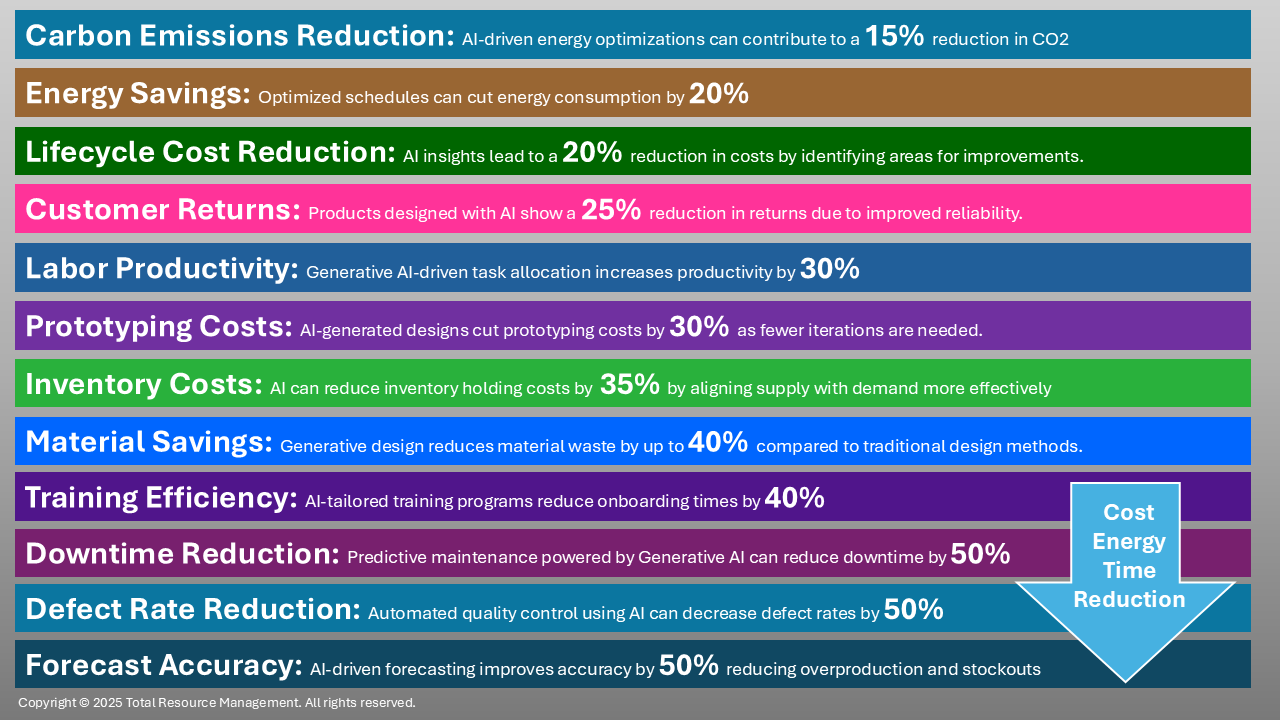
Yes, the process could be changed to remove inefficiencies… but the process would remain largely the same. What if the process is “handed” over to an AI solution for it to take care of the multiple mundane tasks? What if staff only got involved in making a final decision based upon presented information (with a degree of confidence) that they did not have to find? To move the needle of efficiency even a little bit, large changes need to be made. A few seconds here and there for a small team does nothing, so 10’s of minutes or hours of time savings are needed in that context. A few seconds for 1000’s of staff certainly adds up significantly.
What about security?
The security of internal business data and the processes that rely upon it continues to be of utmost importance. There is concern that unleashing the power of Generative AI within a business will result in business products that have no traceability or pedigree, making their usefulness in doubt. This is a valid concern.
Governance of AI products is an element of any AI implementation and has garnered the attention of most AI “vendors.” When an AI tool generates materials, it is important to know where it got the information. The Large Language Models (LLM) that are on the market make clear statements as to how the information was arrived at and filtered. Further, as the business augments the LLMs with their own data, the AI solution becomes smarter for the business given that the business data is well understood and is secure.
Early implementations of AI solution exposed the risk of bias and even hallucinations in the generated content. Not that these problems have been completely stamped out, but the governance tools available go a long way for the business to monitor what the models are producing and make proper adjustments.
Perspectives
No matter the tool or the change, the result must be of measurable benefit to the business. Most likely this benefit is financial in the form of either decreased expenditures or increased revenue, or both. Measurement infers knowing where the business was, when the change(s) were made, and where the business is now as a direct result of the change(s). The CFO of the business may have this perspective along with wanting an understanding of the risk involved and how long the project will take.
The CxO, whose roles are more focused on technology, have their perspectives influenced by security, innovation, and availability of necessary technology. They may also have concerns about the impact the change in technology may have on customers as the solution is initially rolled out. Budgetary differences between hosting solutions either on-prem or out in the cloud and the necessary staff skill sets to support them are areas of concern unique to these roles.
And finally, is the perspective of the CEO. Traditionally their perspective is somewhere between the short-term and the long-term, not giving much attention to the agile nature of the business. As stated earlier, knowing how agile (or not) the business staff and the business itself (given the regulatory environment) will help determine the effectiveness solutions such as Generative AI could be. There is much pressure put on all the C-levels to jump right into the world of AI and in some situations that is very reasonable. However, there is a business to run and bringing together all the perspectives to take a hard look at the organization and make a solid plan to adopt such solutions will set the stage for success. Be smarter. Be first. Or cheat.
Wrap up
TRM has been assisting clients across industries for over 30 years in improving their processes and maximizing the use of their EAM solution. Now with the inclusion of Generative AI solutions in world-class EAM tools such as IBM MAS, the conversation has more nuance to it. Let’s talk about your goals and how we can help you convince the C-level that now is the time to investigate adopting Generative AI solutions to benefit the business in the near and long term.
Ready to elevate your asset management?
Connect with TRM to start your journey toward exceptional performance.
Related Resources
Explore insights, guides, and tools designed to help you unlock greater asset management performance and business value.

Unlock smarter
asset management
Ready to elevate your asset management?
Connect with TRM to start your journey toward
exceptional performance.