Hosting IBM MAS On-Prem vs. Cloud: What to Consider

John Q. Todd
Sr. Business Consultant/Product Researcher Total Resource Management (TRM), Inc.
When it comes to hosting IBM’s Maximo Application Suite (MAS) on the Cloud, there are many options available. Given the variety of industries that have been using Maximo over the years and their unique situations, it has driven the Cloud hosting industry to accommodate these requirements and offer flexible solutions.
Staying on-prem, of course, is an option as well. That topic will be covered in this article, exposing considerations that should be made when making that decision. This article will also discuss security, cost drivers, and what the migration process to the cloud looks like in a typical situation.
Industry Trends
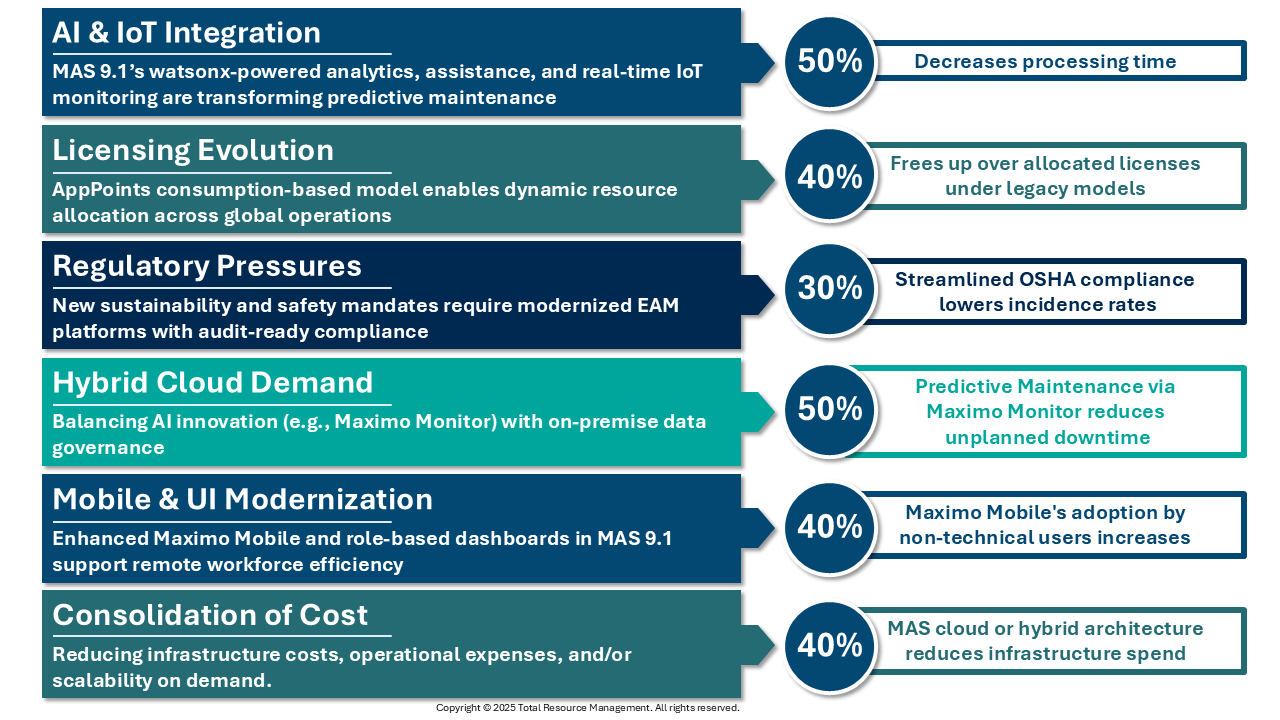
The enterprise asset management (EAM) market is rapidly shifting to cloud solutions, which deliver AI-driven tools, IoT integration, and streamlined administrative processes. Moving to the Cloud also consolidates costs for infrastructure and operations, as well as being able to scale as demand changes.
IBM watsonx with its Granite AI models and the native IoT integrations facilitate predictive maintenance with the goal of reduced unplanned downtime. Some surveyed organizations report as much as a 43% reduction in downtime.
Licensing has moved from legacy methods to a pool of application points that users draw from as they log in, no matter where in the world they are located.
Regulatory pressures continue to force organizations to consider stricter safety, sustainability, and financial optimization efforts. Enterprises are adopting hybrid cloud strategies to balance data integrity needs with AI/ML innovation. Robust governance frameworks are essential in managing AI assets. Version control and compliance are key considerations for Maximo deployments.
User interface design is always evolving, as is the deployment of mobile applications, often as the first app a User would interact with. MAS Mobile delivers current-thought interface design as well as on-line and off-line capabilities and Esri/arcGIS map-based interactions.
Hosting Options
As stated earlier, there are several options available to host MAS.
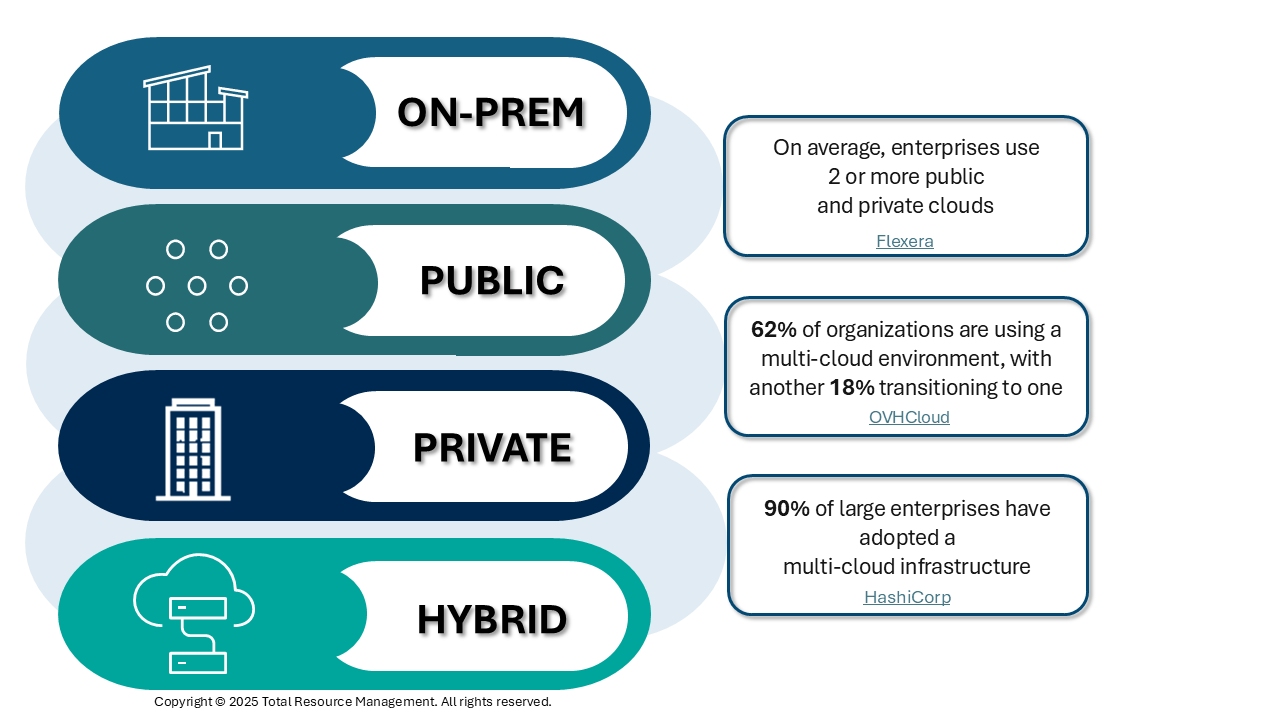
On-prem as the name implies, is hosting MAS applications within the company’s own data center. This option offers the most control and flexibility but comes with higher costs for managing hardware and infrastructure as well as related facility costs associated with security, HVAC, and power requirements.
Public cloud will typically be based on one of the major hyperscalers like Amazon Web Services, Microsoft Azure, or Google Cloud where MAS would be co-located along with other customers. Public clouds offer cost-effective scalability and can be a great choice for companies who want the flexibility of pay-as-go and access to advanced infrastructure without having to manage hardware and supporting facilities.
Private cloud hosting, on the other hand, is dedicated to a single organization. It offers greater control and security—perfect for industries with strict compliance needs, such as healthcare or finance. It should be noted that a private cloud can be created on AWS or Azure, but the client would need to provide the expertise to establish an effective cloud boundary that isolates the applications from other customers.
Hybrid cloud combines both public and private elements. It allows businesses to keep sensitive data and/or applications private while still leveraging the scalability of the public cloud. This model is increasingly popular because it offers the best of both worlds.
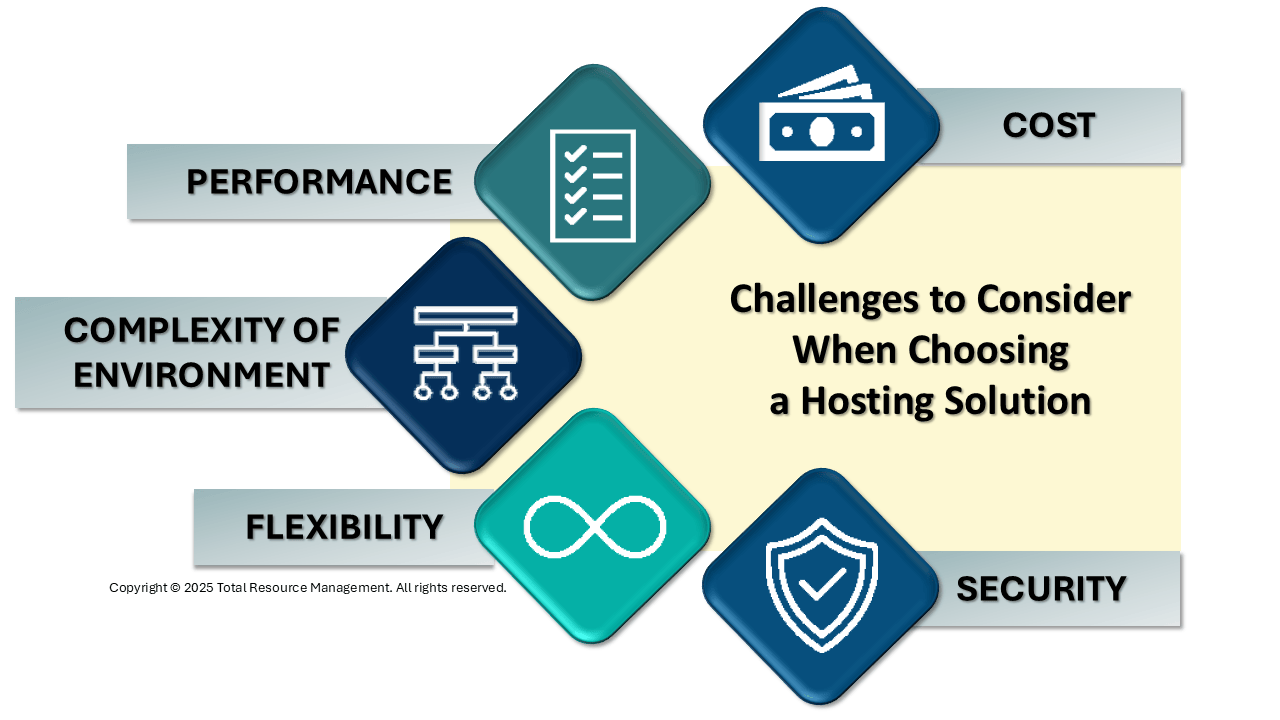
In choosing a cloud hosting solution, there are several factors to be considered such as cost, security, performance, flexibility and complexity of the environment. There is no one-size-fits-all answer.
Factors Influencing Hosting Decisions
There are several factors to consider when deciding which hosting option is right for an organization:
Cost of course, plays a major role. Public cloud hosting is the most affordable but offers less flexibility, while private or on-prem options offer more flexibility at a higher cost.
When it comes to security and compliance, literally every system is vulnerable to attack in some way. This is why security is always at the forefront of hosting decisions. Applications handling sensitive data such as Personally Identifiable Information (PII), critical infrastructure, or federal government data will have stricter standards to comply with, including NIST, NERC CIP, GDPR, or SOC 2.
When thinking about performance, it is important to include any corporate reliability and scalability requirements. Applications with high performance or low latency needs may require dedicated servers, more computing and memory resources, and dedicated networking. Applications with traffic fluctuations will need scalable solutions to handle peak loads.
Flexibility speaks to the hosting provider’s ability to meet a customer’s unique requirements. Clearly, on-premises or dedicated hosting offers full control over the environment. In contrast, managed hosting simplifies maintenance but can limit direct control. So, it is important to understand the limits of what the intended cloud hosting provider offers.
Today’s hosting environment is complex. It includes not just the applications but all the supporting infrastructure that goes with it. Expertise in managing and supporting cloud-based services such as Identity and Access Management, Monitoring, Networking, and Storage options is critical to ensure that all components work together.
On-prem vs. Cloud Hosting
Speaking of on-prem…
With all this talk about moving to the Cloud, one would think we have turned our back on remaining on-prem.
Quite the opposite.
Listed in the graphic are several considerations that could easily make the case for an organization to stay on-prem.
Moving to the Cloud simply might not fit into the strategy the business is currently executing. Maybe the degree of control that is needed over the applications, database, and servers precludes them from being out in the Cloud.
Staff investment could be a consideration if the move to the Cloud demands the need for more highly experienced IT staff.
Then there is the cost. In some situations, the cost of the local data center has already been depreciated and going to the Cloud opens a new set of expense.
No matter the reasons, it is a good idea to get them all out on the table and consider how relevant they are to the current Maximo environment situation.

TRM Cloud Offerings
TRM has two main options for hosting: Commercial and High Security Cloud. While they both offer the same services and performance, they are differentiated by the level of security incorporated into each of the cloud environments. TRM’s cloud solutions further address each of the factors just discussed above.
Cost, Security and Compliance
Both Commercial and High Security Cloud deliver a cost-effective and secure solution that eliminates customer investment in infrastructure or ongoing maintenance costs. By leveraging scalable infrastructure, TRM Cloud can scale up or down based on changing customer demand. This maximizes both efficiency and cost control, which in turn allows TRM to offer very competitive pricing. This helps to reduce overhead, minimize risk and cost, all while maintaining high levels of performance and security.
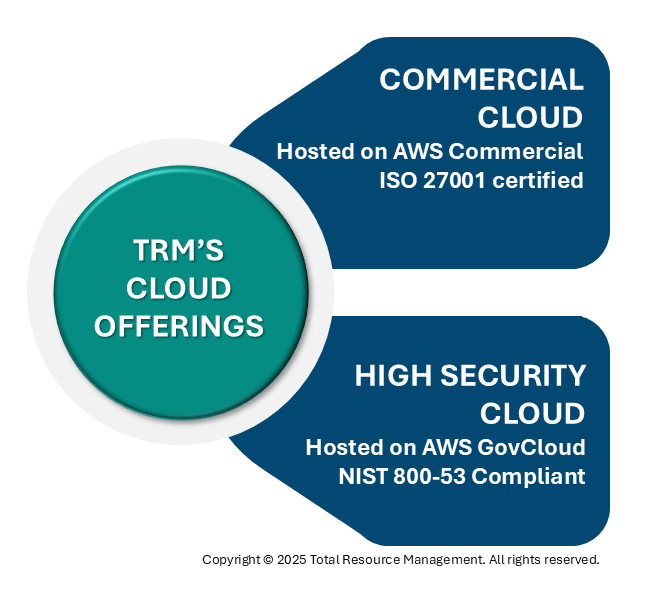
TRM’s Commercial Cloud has been an ISO27001 certified Cloud since 2021. An ISO27001 certification demonstrates that TRM has implemented a systematic and risk-based approach to managing sensitive company and customer information. This includes fully documented policies and procedures as well as annual assessments.
TRM’s High Security Cloud is compliant with NIST 800-53 at the Moderate Impact Risk level. This is a security framework of over 300 security and privacy controls and is the foundation of the Federal Risk and Authorization Management Program, known as FedRAMP. Being compliant with NIST 800-53 means TRM has implemented all the required controls so that for organizations with higher security requirements such as federal agencies or utilities dealing with critical infrastructure, this option is aligned with government-required standards for Cloud use.
TRM is also pursuing SOC 2 certification for both of our Cloud offerings. Our Type I audit is scheduled to begin in Q4 of this 2025 and we expect to achieve our SOC 2 Type 2 certification by Q2 of 2026.
Performance
TRM Cloud Offerings are built on high-performance infrastructure and can maintain 99.9% uptime. We perform real-time monitoring and track metrics such as:
- CPU & memory usage
- Latency
- Error rates
- Disk I/O
- Throughput
We also implement each customer’s MAS environment across multiple data centers to ensure a high level of reliability and resilience. These data centers are located close enough to each other to provide high-speed, low-latency communication.
Each of these data centers have independent power, cooling, and networking. This physical separation protects against data center-level failures like power outages, fires, or hardware issues. If one goes down, the others remain operational.
Flexibility
We offer a great deal of flexibility with both of our cloud offerings. Multi-cloud or hybrid deployments are common with our customers. This allows them to run their workloads where it makes the most sense.
We support a broad range of technologies, from Mobile applications to Database Management systems, SAML, SSO, and more. We allow Database access for custom queries or Business Intelligence Reporting. We support all MAS integration methods and can accommodate other methods as well.
TRM also has options that allow for:
- Flexibility in scheduling upgrades
- Enhanced Disaster Recovery
- Customer Support SLAs
None of this flexibility comes at the cost of security or performance.
Complexity
TRM’s cloud offerings are architected to abstract and simplify the inherent complexity of the underlying infrastructure. We utilize AWS CloudFormation and Terraform to automate and standardize provisioning and operational processes. This ensures consistency, reduces manual errors, accelerates deployment, and reduces operational overhead.
Key AWS services—such as Compute, Storage, Backup Networking, etc. are managed through automation that we have developed, which allows us to deliver uptime guarantees and consistent performance.
Security and compliance are built in from the start. We handle all the necessary and interrelated complexities of isolating workloads, ensuring data encryption, monitoring, and reporting.
In short, we mask the complexity of the infrastructure while preserving its integrity. This means faster onboarding for customers, easier scaling for operations, and a smooth transition to the cloud.
Cost Drivers
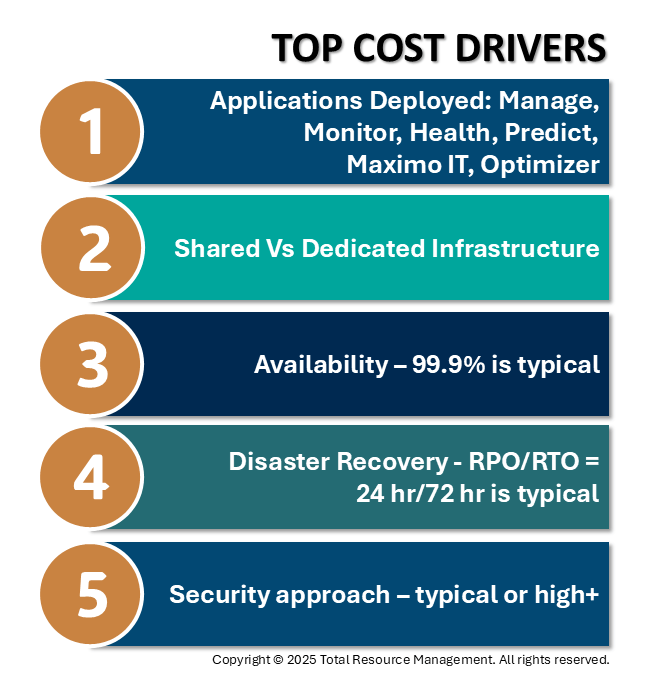
Let’s draw our attention to some of the costs that need to be considered when making the decision to move to the Cloud vs. staying on-prem.
The components of MAS to be deployed will dictate the compute resources that need to be in place, so the environment performs for the users. Careful analysis of the compute needs (initially and on-going) is important… and of course, more compute equals more cost over time. Hosting companies, like TRM, have ways of reducing infrastructure costs through sharing mechanisms across clients. Staying on-prem, the entire infrastructure is at the client’s cost.
Availability is a big deal. There are many options to ensure that the Cloud environment meets availability and disaster recovery goals. While the client may want extremely high availability, the cost to deliver this, not only on-prem, but also in the Cloud, can be prohibitive. When on-prem, all the availability and disaster recovery plans, processes, and necessary hardware are completely in the client’s hands.
Finally, to cover vulnerabilities, security is addressed. A big part of this cost is the continual scanning performed by the cloud provider. With on-prem, security, like everything listed above, is left up to the client.
Cloud Migration Process
Let’s look at a typical move to the Cloud process. Let’s begin with an existing Maximo implementation that is on-prem:
Once all the planning is done, the first technical step is to deploy the MAS instance into the Cloud. Then, a copy of the production Maximo database (Maximo 7.6.1.2 is preferred) is moved to the Cloud as well and upgraded to the most current MAS level. It may take a couple of passes to clear any errors, issues, or to do some basic testing. Once the legacy Maximo data is in the MAS environment, user testing can occur with a Go-Live data set.
This will take anywhere from 3-9 months, depending upon complexity.

Next steps
Total Resource Management (TRM) has been in the Maximo business since 1993. Over the last 10+ years, we have also been hosting and providing Maximo SaaS solutions for our clients across industries.
TRM is in a unique position with not only our across-industry experience, especially those that are heavily regulated, but also our ability to work with clients from the initial planning and requirements gathering all the way to the end of the implementation… and beyond.
TRM has everything you need from start to finish for your digital transformation project. Let us work with your People, Processes, and then Technology to achieve the goals at hand. We also offer Reliability and Maintenance consulting, as well as have a library of add-ons and accelerators that really help to move projects forward.
Reach out to us to discuss what your requirements are and let’s see which options we offer can be supportive. We do have a hosting questionnaire that, once filled out, is a good conversation guide. Of course, we can form a full proposal and project plan that will cover the entire process and any ongoing support.
Ready to elevate your asset management?
Connect with TRM to start your journey toward exceptional performance.
Related Resources
Explore insights, guides, and tools designed to help you unlock greater asset management performance and business value.


Unlock smarter
asset management
Ready to elevate your asset management?
Connect with TRM to start your journey toward
exceptional performance.