Scott Stukel, CMRP, Director of Asset Management and Reliability at Total Resource Management
Originally a paper I submitted and presented at an asset management industry group conference in 2018 but the content is relevant for anyone who would like a simplified entry point to begin to dive into IoT/device based condition based asset management & maintenance, but in a significantly simplified manner.
INTRODUCTION
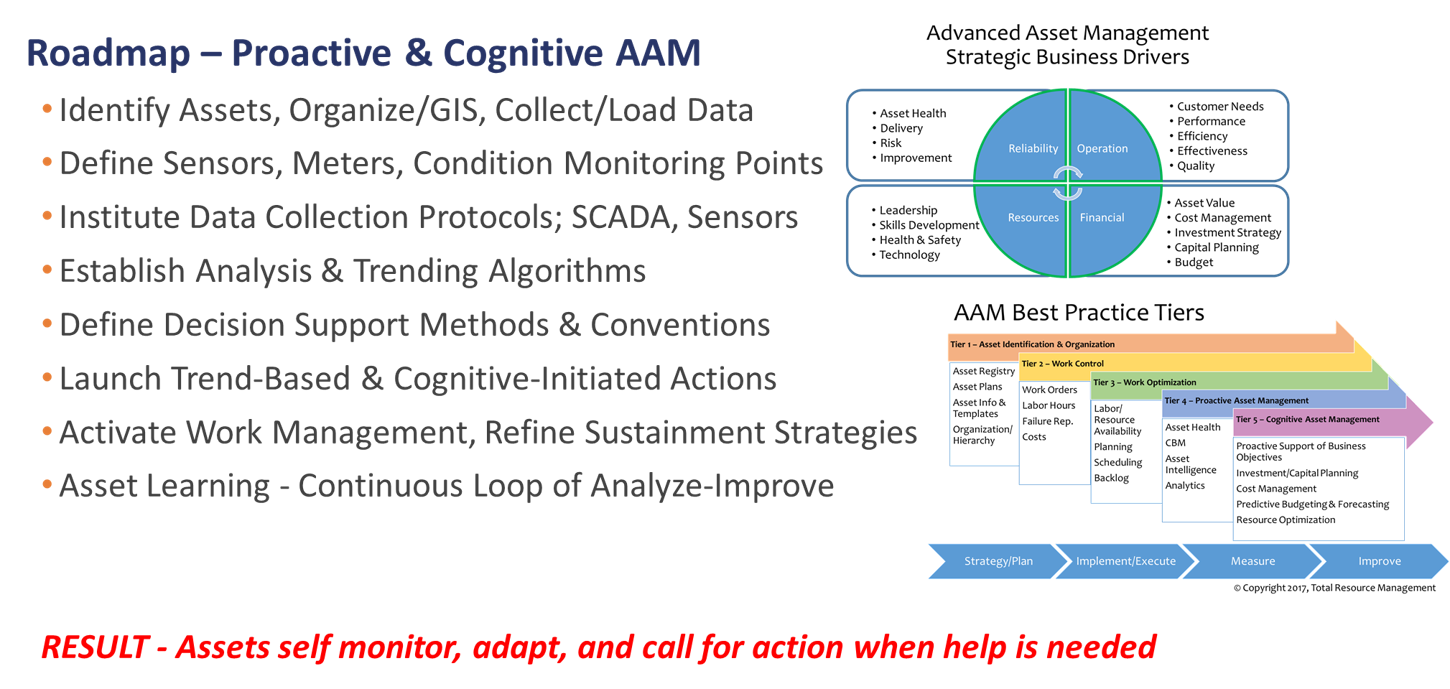
Assets of the future will monitor themselves, make adjustments and ask for help when they need it. How can you take advantage of these advancements? The key is simplifying the approach and making sure you have the foundational blocks in place to be successful. This paper will lead readers through the evolution it takes to set the groundwork for asset(s) organization, work control and work/resource optimization to set the stage for proactive and cognitive asset intelligence.
The universe of empowering Intelligent Asset reliability involves understanding how they function, how they fail, and what can be done to prevent/mitigate those failures. In addition to asset reliability, there are other equally important additional asset-centric factors such as sustainment models, maintenance/engineering impacts to availability, and the effort/cost required to care for and maintain equipment and infrastructure through their lifecycle; all of which need to be considered when fitting the asset management puzzle together.
A majority of asset intensive organizations have been exposed to the innovative IoT solutions and technology that is quickly evolving. It is cool and exciting and asset owners are interested in investing in the tools necessary to get them there today however few have the holistic vision and foundational processes, methods, technologies, tools, and data to be successful. As they dig deeper they have resoundingly found that it is a nebulous undertaking. It is challenging to frame the vision for their Intelligent Assets of the future and even more difficult to understand where to start and what they need to do to establish the foundation and execute the vision. Communicating the vision, gaining stakeholder support, and understanding how it will impact the traditional culture and practices of the organization are even more steep peaks to climb. The seemingly monumental effort and change necessary to be successful with Cognitive Asset Intelligence leads to organizations who need it most to question the value or to steer away from it altogether.
The reality is that it isn’t as hard as it may seem. Advanced Asset Management methods and tools can become part of day to day operation while delivering significant tangible value and making everyone’s job easier. The key is to keep it simple and practical. Focus on the desired business outcomes, start with establishing the foundation, ease into it by beginning with a concentrated subset of asset(s), and use empirical asset health data & metrics to lead you to where you should expand the footprint.
In the remainder of this paper we will lay out how to frame the topic of Advanced Asset Management in the Cognitive Asset Intelligence arena by concentrating on:
- The vision of the Intelligent Asset, why it matters, and what does it mean to you,
- Cognitive Asset Management tied to key business drivers,
- The Roadmap to success for achieving Intelligent Asset value.
THE VISION OF THE INTELLIGENT ASSET
Assets of the future will monitor themselves, make adjustments, and ask for assistance when they need it. Modern machines are equipped with rapidly expanding technology that provides observational information about operating parameters, physical conditions, failures, and a myriad of other elements. It is a true art to be able to pull together relevant available data while simplifying the cognitive asset model to implement a straightforward sustainable solution that is not cost prohibitive and produces intended benefits.
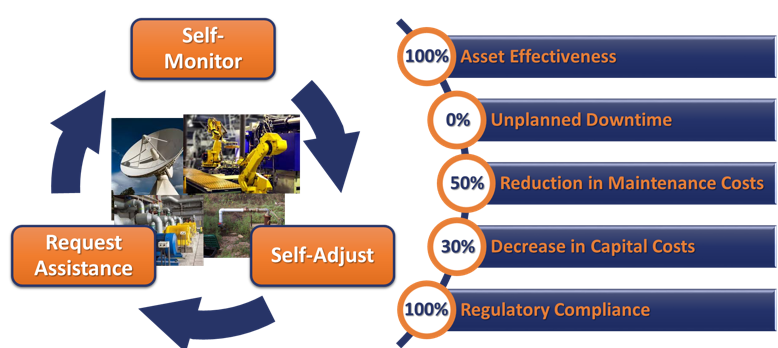
From a practical sense, let’s examine your automobile. Nearly every car sold today has mature sensing, monitoring, and diagnostic technology incorporated into their design. When you start the engine, you are immediately informed of any issues with temperature, improperly functioning equipment, tire pressure, and others. In addition, the diagnostic features tell you which of your tires is low, it is time for an oil change, or that you need to take it in for service. Much of the equipment you install such pumps, motors, compressors, HVAC units, and others contains on-board sensors and monitoring capability however it is typically only used for operation of the equipment and is seldom incorporated into maintenance or sustainment other than to alert system operators to anomalies. It is ironic that a $30,000 automobile has much more advanced capabilities than many million dollar pieces of industrial equipment. Through a common sense approach to coupling basic asset management principles with the leveraging of available technologies and analytical models you can accomplish futuristic results today.
Visualize in your plant a reciprocating compressor. On this compressor there are a lot of mechanical parts, electrical components, and instrumentation. Its recurring maintenance strategy involves a significant amount of effort to inspect and maintain the asset. Most of these activities are manual and require maintenance personnel to execute. A sample routine maintenance program is as follows.
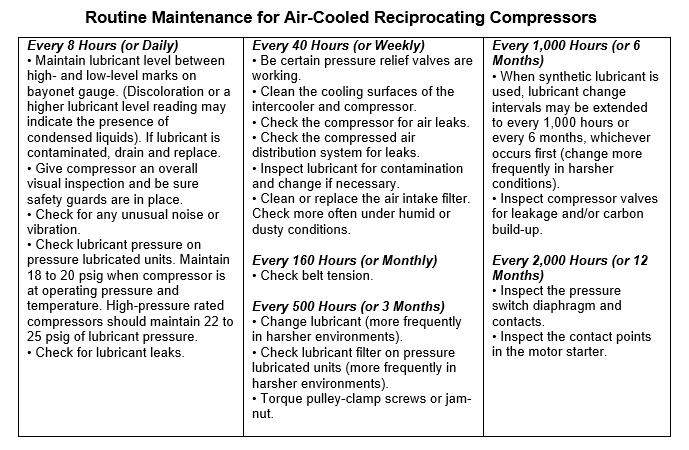
The future-now compressor, fitted with sensors and technology, can reduce or eliminate the need to physically travel to the equipment and perform the inspections or adjustments called out by the plan. Note that just because a solution is possible, cost to implement and sustain the technology must be taken into consideration to define if the return is worth the investment.
An example of how this may be employed can be found in the table below.

As the example above illustrates, there is tremendous value in enabling assets to monitor themselves, make adjustments, and let us know when they need help. This does not eliminate the need for operators, maintenance technicians, and engineers. Science fiction movies vividly depict the world of artificial intelligence as robots, machines, and computers that do not need humans, even viewing us as threats that must be eliminated. That depiction, albeit entertaining, does not represent the reality of today. The present vision of the Intelligent Asset does not eliminate the need for human beings, quite to the contrary. Even though we’re helping our equipment become smarter and somewhat self-sufficient, we still need the machine people partnership to achieve the optimum outcomes. Intelligent assets that are enabled to monitor events and conditions in fact free up our maintenance staff and reliability engineers to focus on additional improvement that further help those assets to be more reliable, available, and maintainable. It allows our people to work smarter instead of wasting time performing cumbersome inspections and recording condition parameters, only to bring them back to the office where someone needs to analyze the data and manually trigger action.
This portrayal of Intelligent Assets and the value of employing Proactive & Cognitive Asset Management philosophies, at face value, sounds like a no-brainer to jump into. Companies frequently sink incredible amounts of money into “cool” solutions and technology on a well presented sales pitch alone without doing their homework to determine whether the investment is worth the return. If we, as asset management professionals, are true to our sworn duty to ensure and protect the value of our assets we must assess how the solutions we propose support the business strategy of organization and how they can advance the mission of our assets.
COGNITIVE ASSET MANAGEMENT TIED TO KEY BUSINESS DRIVERS
Every business has a mission, a purpose and reason for being. Underneath that lies the strategy which defines the business drivers that support effective execution of the mission. All organizations that still exist can boast that they are doing things right. However, when you pop the hood, you find that they experience varying levels of success. Modern society believes that everyone and everything can always be improved. Cognitive Asset Intelligence is only one of many methods to achieve improvement. It is a significant undertaking, and is a monumental change in philosophy from the old way of managing assets therefore it is met with skepticism and resistance. Experience has shown that the best way to erode those barriers is to show how advanced asset management practices can improve asset reliability, availability, & maintainability, reduce costs, and provide for safer and more content workers. The magic formula to making this happen is to connect the dots from the asset solutions to key business drivers of the organization.