
Why Now is the Best Time to Upgrade Maximo to MAS

John Q. Todd
Sr. Business Consultant/Product Researcher Total Resource Management (TRM), Inc.
As the end of support for Maximo 7.6 is less than one year away in September 2025, now is the time to begin making decisions about how the upgrade from Maximo to MAS should go. As with any upgrade there are many moving pieces to consider. The goal of any upgrade is for the user communities who rely upon the solution to perform their functions without interruption and more efficiently than before.
Aside from the end of support deadline, based upon the years of performing upgrades of this sort, TRM suggests an end-to-end project plan that may span 9 to 12 months for a medium complexity Maximo environment. Having a clear picture of the project all the way through the go live and post go live support is critical.
Start with the end goal and work backwards
Every organization has seasons and periods of time where any sort of upgrade of a critical business system is not a good idea. Knowing when these “freeze” periods are mandated during the year is important to consider when planning the upgrade to MAS. Consider any other organizational changes as well that are occurring during the same period that may cause competition for resources.

With the end goal of a fully transitioned system, and a satisfied user community blocked out on the future calendar, then the process of filling in the necessary tasks and who will be performing them can begin.
High level project plan
In general, the upgrade from Maximo 7.6 to MAS is a “new implementation.” It is certainly not an “in place” upgrade. Given that MAS runs on top of the RedHat OpenShift operating environment, a brand-new set of servers (physical or virtual) will need to be stood up either on prem or out in the cloud. This decision to stay on-prem or go into the cloud can be a significant hurdle for the organization and may take a fair amount of time for many different people to arrive at a conclusion.
Aside from the actual technical upgrade process, which is rather straightforward, upgrades such as these present opportunities to review and refine business processes, consolidate functionality across existing systems, and the development of a data archival program.

It is highly likely that the current Maximo system has been modified to suit the business over the years. These configurations or customizations may be well documented… or not. While the Maximo to MAS upgrade process does account for these nuances, it is a good idea to review each of them and see if they are still needed. Further, a review of the business processes that are related is a good idea to see where steps can be eliminated.
Over time, organizations will gather several enterprise solutions and only use a small percentage of the functionality each contains. In essence the business is playing for little used and duplicated functionality. Given that solutions such as MAS contain across-discipline features/functions, part of the upgrade planning should be a consideration where consolidation could occur. Perhaps some costly external or satellite systems that are currently interfaced with Maximo could be eliminated.
And finally, is the notion of a data archival program if one is not already in place. If the current Maximo environment is holding 20 years of transactional data, it might be prudent to archive most of this valuable corporate knowledge into a data lake and make it available via tools such as IBM Cognos, Microsoft PowerBI, or Tableau for users to perform research about the past. Allow the new MAS system to be a rolling window of perhaps the last 2-3 years vs. having to drag all 20 years along. A data archival program is a project unto itself so it will need to be equally planned for success.
AppPoints
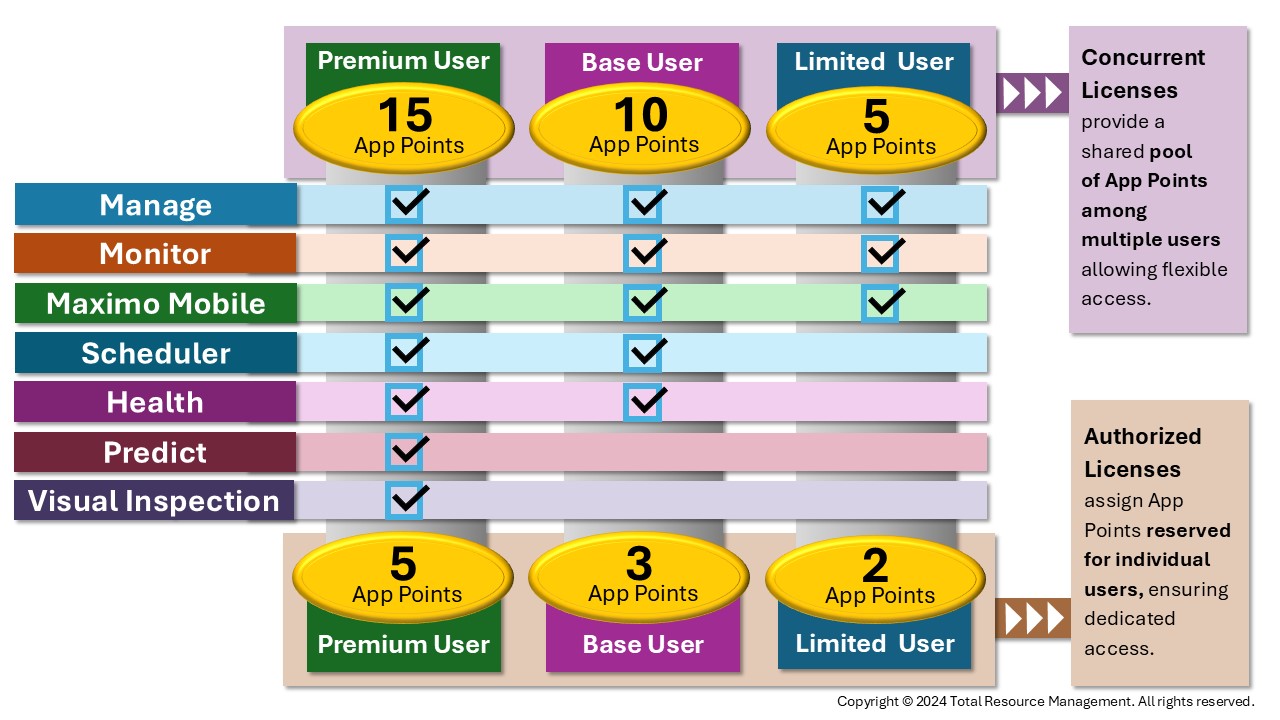
MAS is licensed very differently than Maximo. With the advent of AppPoints, any previous licensing scheme the organization has had for Maximo will be converted to AppPoints. Part of the pre-planning for the upgrade is to perform this conversion via IBM or a business partner so that the organization is entitled to the MAS products. Only then can the upgrade process begin.
There are scripts and calculators available to determine the actual current license usage and how that looks in an AppPoints scheme. This also prompts the notion of ensuring the users and security groups in the current Maximo are configured correctly to gain a proper picture of system usage. No need to carry forward defunct users and broad access into the new system.
Availability of people to perform the upgrade
Unless the organization plans on performing the upgrade on its own, contracting with and scheduling external organizations may be difficult. In the market today there are 1000’s of upgrades going on worldwide, absorbing the time of not only the organizations but IBM business partners as well. It is becoming common for upgrades to be delayed several months for schedules and workloads to be aligned simply due to the people not being available to work on the project.
Wrap up
Given the end-to-end project of upgrading to MAS can easily take 9 to 12 months it is reasonable to state that now is a good time to begin the process. Hopefully a year ago someone thought about budgeting for the project so that hurdle is in the past.
TRM has been helping organizations deploy and maintain the IBM Maximo solution for over 30 years. We were an early adopter of IBM MAS, so we now have several years performing upgrades not only to our Cloud services, but on-premises as well. Further, TRM has many years of experience in assisting in process improvement efforts both big and small. Contact us to see how we might be able to help you with your Maximo to MAS upgrade.
Ready to elevate your asset management?
Connect with TRM to start your journey toward exceptional performance.
Related Resources
Explore insights, guides, and tools designed to help you unlock greater asset management performance and business value.

Unlock smarter
asset management
Ready to elevate your asset management?
Connect with TRM to start your journey toward
exceptional performance.